



- R+D & Community of Interest
- Translated with AI
Cleaning robot vacuums, mops, and empties paper bins
Trade Fair CMS – Cleaning Management Services
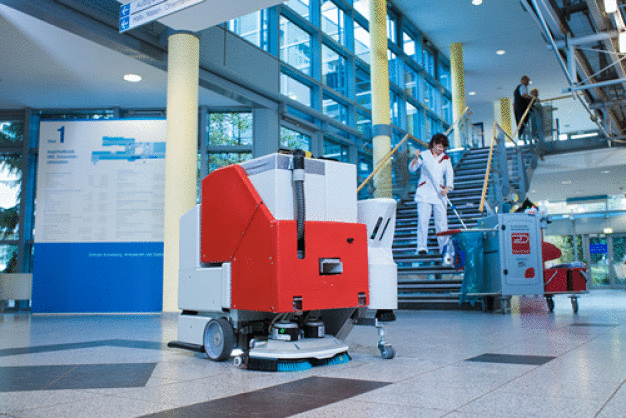
The cleaning robot with wet cleaning module during practical testing in a hospital. (Source: Dussmann Group/Photographer: Kay Herschelmann)
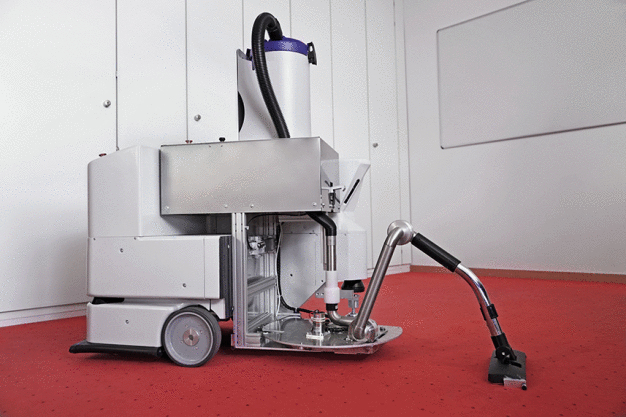
The cleaning robot with the vacuum module during testing in the office rooms of Dussmann headquarters in Berlin. (Source: Fraunhofer IPA)
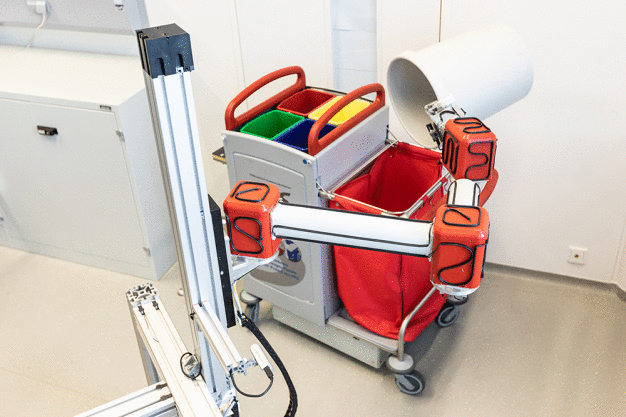
The robotic arm can independently recognize paper bins, grasp them, and empty their contents into a collection container. (Source: Fraunhofer IPA / Photo: Rainer Bez)
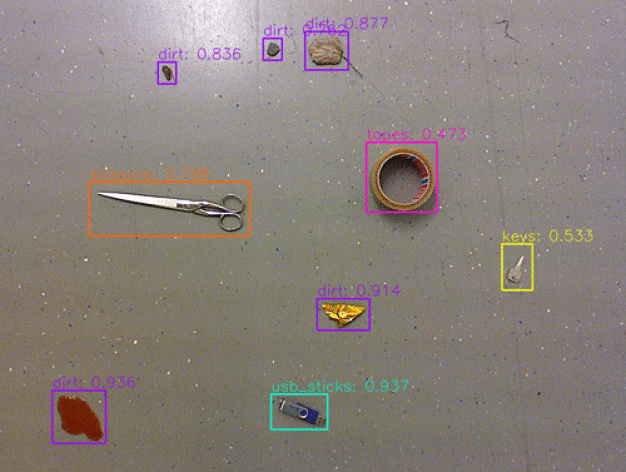
The software developed at Fraunhofer IPA automatically detects dirt particles and distinguishes them from office objects that could also be lying on the floor. (Source: Fraunhofer IPA)
The prototype of a mobile cleaning robot has been developed in the research project »BakeR«, which thanks to its modular construction can perform various tasks. The project presents the robot and its capabilities at the trade fair for cleaning and hygiene CMS in Berlin from September 24 to 27, 2019, in Hall 1.2 at booth 201 of the project partner Kenter.
The goal of the »BakeR« project (Modular system for cost-efficient, modular cleaning robots) was to develop a service robot that can be easily adapted to different cleaning tasks. This can relieve cleaning staff and support them in their work – ideally throughout the night. This support is crucial given industry challenges such as increasing cost pressure, staff shortages, and staff turnover. Additionally, a cleaning robot is particularly suitable for sensitive areas where only trusted personnel could otherwise clean.
The project resulted in an autonomous mobile robot platform, modules for wet cleaning and vacuuming, and a flexible robotic arm. Depending on the location and cleaning process, the robot can select and attach the appropriate module itself.
Detailed cleaning planning and documentation
The robot plans its work based on available object information such as the room book, which contains basic information about individual rooms, and the patrol plan, which defines the services to be performed there. With this information, the robot can automatically segment the area to be cleaned into individual rooms. Building on this, it calculates an optimal cleaning sequence and generates systematic travel patterns for inspection or surface cleaning within the rooms. It also considers where vacuuming and wet wiping are necessary. After cleaning is completed, the user receives a digital cleaning report that documents all activities performed, ensuring transparency.
Variable cleaning functionalities
For the developed cleaning modules, it was important that the robot can automatically switch between them and that additional modules can be added in the future. "Potential users need to be able to utilize the robot optimally. Because this is essential for economical operation," explains Dr. Birgit Graf, head of the BakeR project and group leader at Fraunhofer IPA.
The developed wet wiping module uses a modified wet scrubber that is compactly integrated with water tanks. This version of the robot was tested by the project partners at a hospital at the end of 2018. During the tests, several employees of the project partner and FM service provider Dussmann Service simulated a complete deployment process with the robot and evaluated operation and performance. The initial feedback from the surveys was satisfactory: the water supply and disposal are ergonomically designed, and cleaning the device is simple. Identified areas for improvement, which were considered in the module revision, included the robot's noise level. Additionally, the project partners optimized the contact pressure of the cleaning module and the associated cleaning quality, as well as the robot’s driving strategy. To verify cleaning results, they also developed a software component that can detect streaks.
The dry cleaning module is based on a commercially available cordless vacuum cleaner, adapted for integration into the robot. Using special actuators, the brush head of the vacuum can be moved forward, backward, and sideways. This allows access to hard-to-reach areas such as floor surfaces under tables. Unlike wet cleaning, the entire area to be covered is not cleaned at once. Instead, in line with the increasingly demanded "result-oriented cleaning," the robot can automatically detect dirt with software, move directly to it, and remove it. The software can distinguish between dirt and typical office objects such as pens or scissors. The latter are not to be picked up by the robot. The cleaning robot equipped with the suction module was tested in mid-2019 at Dussmann Service's headquarters in Berlin. The employees showed great interest and considered the underlying concept to be sensible and useful.
Doors and paper bins at hand
Besides floor cleaning, office cleaning includes other handling tasks that are no problem for a human cleaner but pose a challenge for robots. Humans naturally open office doors, move a chair to reach under the table with the vacuum, or pick up a paper bin to empty it. "We wanted to transfer these skills to the robot and thus expand its possible applications," adds Graf.
The third module developed in the project is a robotic arm with a special gripper. Object recognition software indicates to the robot where the objects to be grasped are located. Software for mobile manipulation plans the movement and grasping of the robotic arm to perform the desired handling task.
The cleaning robot presented at the CMS trade fair is the result of a three-and-a-half-year collaboration among research, application, and technology partners. Kentner, Metralabs, and Amtec built the robot. Fraunhofer IPA developed the underlying software components for segmentation and surface coverage of the deployment environment, for object, dirt, and streak recognition, and for mobile manipulation. Dussmann Service, as an experienced cleaning service provider, defined the practical requirements and evaluated the cleaning modules. The trade fair presentation marks the conclusion of the project, which ends on September 30.

Fraunhofer-Institut für Produktionstechnik und Automatisierung IPA
Nobelstraße 12
70569 Stuttgart
Germany
Phone: +49 711 970 1667
email: joerg-dieter.walz@ipa.fraunhofer.de
Internet: http://www.ipa.fraunhofer.de



