




- Water
- Translated with AI
Clean matter
Stainless Steel Resistant to Rust in the Mineral Water Industry
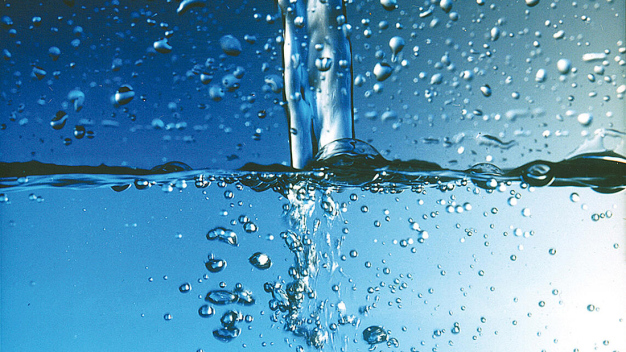
In Germany, approximately 150 mineral springs fill over twelve billion liters of mineral and healing water annually. © Information Center for German Mineral Water (IDM)
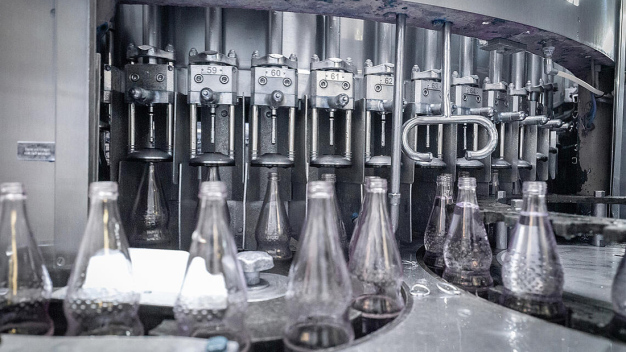
Custom-made stainless steel plants are an established standard in the mineral water industry. © Information Center German Mineral Water (IDM)
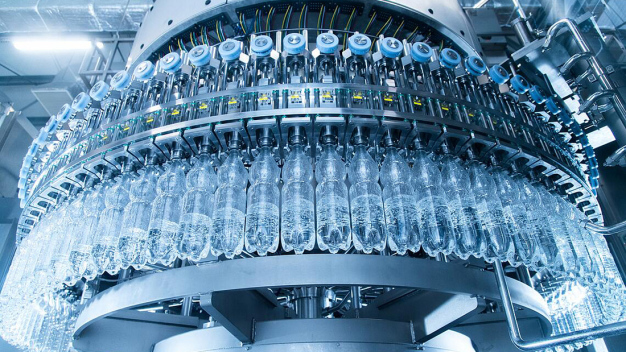
Stainless steel corrosion-resistant is used for the filling systems employed in production.© Krones AG
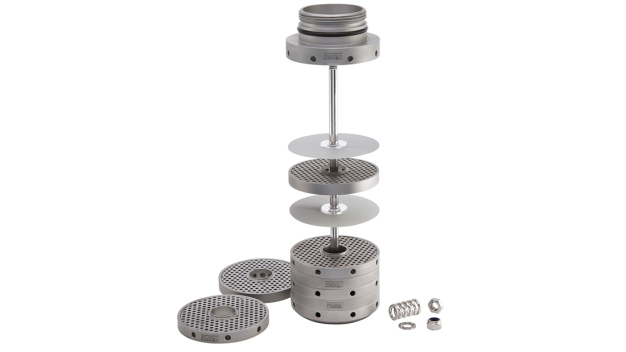
For the guaranteed process and product integrity, a system of stainless steel filters of different fineness levels for liquids, compressed air, gases, and steam is of crucial importance. © WZV / Pentair
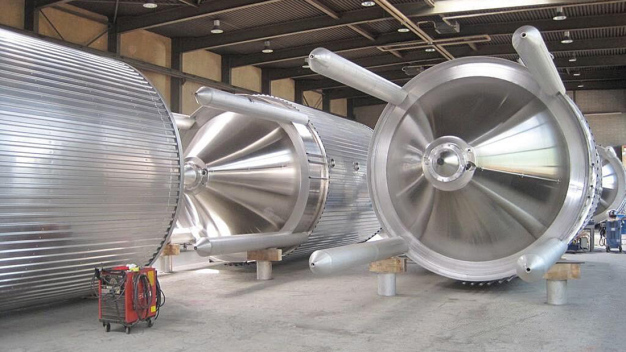
For complete emptying and thorough cleaning of the tanks, the mostly cylindrical containers made of stainless steel are also often equipped with a convex or conical bottom. © WZV / Bolz Edel
In Germany, approximately 150 mineral spring companies produce over twelve billion liters of mineral and medicinal water annually. High requirements for secured hygiene, quality, and environmental compatibility must be balanced with sustainable economic efficiency of production. Additionally, the industry has set a goal to operate climate-neutrally by the year 2030. Today, the production of mineral water is characterized by state-of-the-art integrated processes with continuous hygienic design from inflow to product filling. Tailored systems made of stainless steel, established as standard, are designed according to specific conditions—water properties, process, chemical conditions, and taste requirements of the final product.
Water is not the same: origin, properties, and type of treatment determine whether it is mineral, medicinal, spring, or bottled water. In Europe, mineral water is a protected designation for natural groundwater. The German Mineral and Drinking Water Ordinance defines it as “water of original purity from underground water sources protected from contamination.” Natural mineral water must, according to these standards, have a high and constant mineral content, be of high purity, originate from a spring, and be bottled directly at the source. Medicinal water additionally has the status of a medicinal product due to its special mineral and trace element content. Spring water is characterized by fluctuating and generally lower mineral content. Bottled water comes from various wells, lakes, or rivers and contains only a small natural mineral content, which is balanced during treatment by artificial mineralization. To provide consumers with clarity about the water quality, German law requires that the bottle label states the source location, ingredients, and the name of the authorized testing institute.
In 2022, 10.1 billion liters of mineral and medicinal water were sold in Germany—more than 500 different mineral waters and 35 medicinal waters. One-third of these were carbonated with carbon dioxide (CO2), with 42 percent containing only a small amount. Carbon dioxide is produced by the reaction of carbon dioxide with water. Some mineral waters are already naturally carbonated at the source.
Running: From the source to the bottle
Depending on the properties of the water source, the water is initially demineralized, degassed, and possibly desorbed after extraction to remove dissolved oxygen. Oxygen reduces the shelf life of water. Additionally, insufficiently degassed water can foam and may alter the taste through irregular carbonation. When the water is infused with natural spring carbon dioxide, the CO2 content from bound and free carbonic acid is first separated, concentrated, and liquefied. It is then stored in tanks, re-evaporated, and precisely dosed back into the water during bottling. For bottling in PET bottles, bottle blowing machines are the next step in mineral water production. Glass bottles are first sorted by color, cleaned under cleanroom-like conditions, stripped of labels, and then checked for breakage or residual contamination. Both bottle types then go through labeling machines; for carbonated varieties, a carbonator adds carbon dioxide gas before they reach the filling line. Depending on requirements, processing, and water properties, high-grade stainless steel fittings are used for the equipment involved in production.
Safety first: Stainless steel in the mineral water industry
Four material grades are established in mineral water production: For equipment and devices that only come into contact with mildly acidic or alkaline solutions, material grade 1.4301 often suffices. A significantly higher resistance to corrosion and erosion is provided by the austenitic stainless steel grade 1.4404, which contains 2-2.5 percent molybdenum. Many food and beverage industry plants are therefore made from this stainless steel. Its good processing properties due to lower carbon content are also advantageous. The also corrosion-resistant, non-rusting austenitic steel 1.4435 falls under the American standard designation AISI 316L, due to similar properties as grade 1.4404. Its high-gloss polishability gives it an excellent surface finish. The non-rusting austenitic special steel 1.4539 offers particularly good resistance against pitting, stress corrosion, and intergranular corrosion thanks to its high molybdenum content and the addition of copper, combined with a very low carbon content.
Pure and essential: Key function for filters
For process and product integrity, a system of stainless steel filters of varying fineness for liquids, compressed air, gases, and steam is crucial. Incoming spring water is pre-filtered with a 25-micron filter to remove deposits, dirt particles, and larger microorganisms. Water used for diluting Cleaning in Place (CIP) reagents first passes through a depth filtration with a five-micron filter. The critical sterile final filtration before bottling, which ensures product purity, requires membrane filters with a 0.2-micron filtration fineness. Microorganisms are removed from compressed air via sterile filtration, which is used for bottle aeration. Buffer or storage tanks are equipped with vent filters to prevent contamination from ambient air. For consumables such as filter packs, candles, cartridges, or membranes, high-quality stainless steel—such as material grade 1.4404—is essential. Besides the strength required for the flow rates, these materials offer long-term resistance to chemical and mechanical cleaning, temperature stability, sterilizability, and high precision in particle retention due to their absolute pore sizes.
Secure containers: Tanks and vessels
Process and storage tanks such as storage, buffer, and filling tanks, CIP tanks, or steam boilers require stainless steel constructions of the highest quality. For this purpose, grades 1.4404 and 1.4435 are used most frequently. Modern manufacturing technologies complement the requirements for hygienic, sterile tanks according to the guidelines of the European Hygienic Engineering & Design Group (EHEDG). EHEDG standards specify a surface roughness of Ra ≤ 0.8 micrometers for each component and weld seam in food tank construction. Tanks must not have dead spaces, crevices, or sharp edges, nor contain screws or springs inside. Valves, seals, and sensors used in the tanks must also have EHEDG certification. The use of corrosion-resistant, acid-proof stainless steel ensures the required corrosion resistance, prevents bacterial growth in stored products, and protects contents from environmental influences. For complete emptying and thorough cleaning, the typically cylindrical tanks are often equipped with convex or conical bottoms. Depending on customer requirements, heating and cooling jackets, agitators, and CIP connections are added to the tank design.
Hygiene requirements are also very high for pumps and agitators used in mineral water production. Whether rotary piston pumps for transfer, dispensing, mixing, dosing, or filling, liquid ring vacuum pumps for bottle filling, or peripheral gear pumps that deliver small quantities pulsation-free against high pressures: compliance with all applicable food industry standards through hygienic and ultra-pure processes is essential. Heavy-walled pump housings made of rolled and deep-drawn stainless steel grades 1.4404, 1.4435, or 1.4539 with dead space- and crevice-free flow chambers and electro-polished surfaces for media-contact parts with Ra ≤ 0.4 micrometers are standard. CIP and sterilization-in-place (SIP) capabilities at sterilization temperatures up to 140°C are common practice. Agitators with robust, hygienic motors, with critical components made of stainless steel grade 1.4571, ensure complete mixing of tank contents. Even here, stainless steel maintains the high corrosion resistance required by EHEDG, despite constant water contact and aggressive cleaning chemicals. This reliably prevents wear and breakage, thus avoiding contamination of the final product. Process-wide—whether during transport between units or as filling pipes—stainless steel pipes and valves of grade 1.4404 also contribute significantly to hygiene and sterility in the mineral water industry, while simultaneously optimizing flow properties.
Warenzeichenverband Edelstahl Rostfrei e.V.
40237 Düsseldorf
Germany



