

- mobility of the future
- Translated with AI
Circular Economy Fuel Cell: One life is not enough
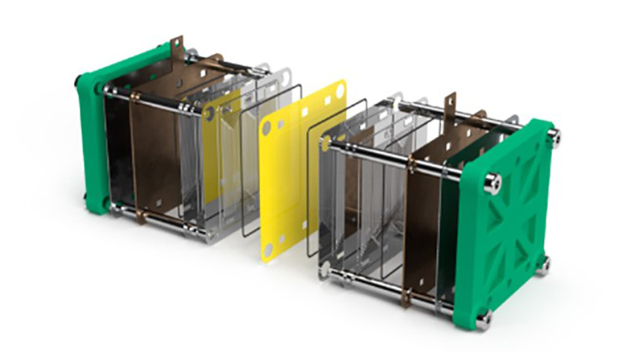
Many components in fuel cells are reusable or recyclable — if the fuel cell was designed for it and automated disassembly processes are available. © Fraunhofer IWU
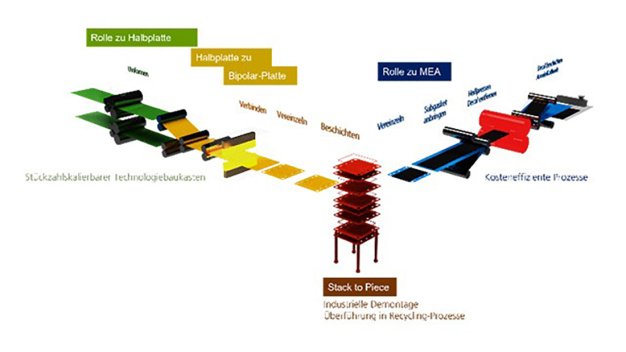
The H2GO-Composite Stack2P (Stack to Piece) investigates which machines, systems, and processes are needed to automate the assembly of fuel cell systems and to disassemble them at the end of their product life without destruction. Project partners are the Fraunhofer Institutes IST, IWU, IKTS, and IFAM. © Fraunhofer IWU
How must stacks of fuel cells (stacks) in vehicles be designed so that the materials used can be dismantled, recycled, or ideally even reused in automated processes at the end of the product's lifecycle? Four Fraunhofer Institutes are exploring this question within the Stack to Piece (Stack2P) consortium of the National Action Plan for Fuel Cell Production (H2GO). The goal: to influence the product design of stacks even before the start of industrial mass production in such a way that damage-free disassembly is facilitated. Because intelligent product design and efficient disassembly processes are crucial prerequisites to enable as many components as possible from decommissioned stacks to be given a second life. The world's first research facility for fully automated disassembly of stacks is now starting operation at the Open Hybrid LabFactory research campus in Wolfsburg as part of Stack2P.
The Fraunhofer IWU coordinates a total of 19 Fraunhofer Institutes within H2GO to lay the groundwork for efficient mass production of fuel cell systems. The focus is on mobile applications, specifically on fuel cells that convert hydrogen into electricity onboard a commercial vehicle.
An important part of this action plan is the Stack2P consortium (Stack to Piece), which aims to ensure the circularity of these production concepts. The Fraunhofer Institutes IWU (at the Wolfsburg site), IFAM, and IKTS are pooling their efforts under the leadership of Fraunhofer IST. The project aims to develop a comprehensive concept for the reuse, refurbishment, repair, or—where unavoidable—recycling of all parts and components of the stack. For example: housings should be designed to be reusable multiple times. Even seals will in the future be largely recyclable.
Challenging mechanical separation of components
Disassembly processes must consider the complex structure of fuel cell systems. The core of a fuel cell is the Membrane Electrode Assembly (MEA) with the proton exchange membrane, where the conversion of chemical energy into electrical energy takes place. The MEA is enclosed by two bipolar plates. Several fuel cells connected in series form a stack. When disassembling a stack without damage, numerous connection points must be released, taking care not to damage the bipolar plates, which are at most 0.10 mm thick.
Current disassembly processes are largely manual and not suitable for future efficient recovery of parts and components on an industrial scale. Therefore, Stack2P considers the entire process chain, from data collection (type of stack) to de-stacking (removal) and automated separation of all components, up to the extraction of the MEA. The Fraunhofer IKTS assesses the condition of the fuel cells at the end of their service life; Fraunhofer IST is developing a recycling line and sustainable recycling concepts for PEM fuel cells. A focus is on chemical processes for disassembling the MEA to recover the expensive precious metal platinum.
Work areas for Fraunhofer IWU include procedures for mechanically separating components, i.e., automated disassembly processes including recognizing and releasing connection points, and ultimately developing guidelines and processes for product and production. In Wolfsburg, Fraunhofer IWU, together with industry partner Aumann Limbach-Oberfrohnau GmbH, is building a research facility for fully automated disassembly of fuel cell stacks; simultaneously, Fraunhofer IFAM is establishing a de-stacking module at the Bremen site to gain insights into adhesive bonds.
Industrial-scale series system derived from research facility
Thanks to the unique research facility designed by Fraunhofer IWU and Aumann, it will be possible after project completion to develop series systems for the sorted separation of all components of a fuel cell system on an industrial scale. Key to later scaling of the facility are insights into cycle times. In pilot operation, the process begins with a 10-second cycle for de-stacking; for later industrial series operation, a reduction to around 1 second is targeted. Equally important, however, is what the research team led by Dennis Weintraut M. Sc. can learn from the project for an optimized design of fuel cell systems in their first product life—so that many more product lives can follow: "With the pilot plant developed in the project, we can automate the disassembly of fuel cell systems for the first time. We want to keep important raw materials in the cycle to conserve resources and reduce dependence on imports."
Fraunhofer-Institut für Schicht- und Oberflächentechnik IST
38108 Braunschweig
Germany