




- Translated with AI
Chinese visiting scientist researches new plastics based on renewable raw materials
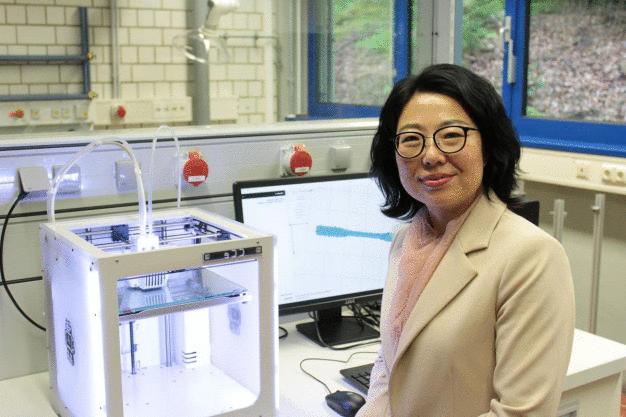
The Chinese professor Dr. Xinyan Shi is currently visiting the campus. (Photo: Sebastian Kamerling/Ce)
The Chinese Professor Dr. Xinyan Shi from Qingdao University of Science and Technology (QUST) is currently visiting the Technical University of Kaiserslautern (TUK). At the Chair of Composite Materials, the researcher is working on 3D printing of plastics. The special feature: renewable raw material cellulose is used, which is intended to improve the properties of the printed components. Shi is participating in a research project at TUK, supported by the German Academic Exchange Service (DAAD).
With the help of 3D printing techniques, complex plastic components can be easily produced, for example. The team around Professor Dr. Alois Schlarb at the Chair of Composite Materials also works with this technology. Together with Professor Shi, the researchers are investigating how cellulose can be used in such plastics. This is the specialist area of the visiting scientist and her research group. Cellulose is a long-chain sugar molecule. It makes up the main component of plant cell walls and is produced, for example, during wood processing.
The Kaiserslautern research team is working on incorporating so-called nanocrystalline cellulose (CNC) into their plastics. It has particularly good mechanical properties, as well as high strength and stiffness, which benefits the finished printed part. In this process, it is important that the cellulose particles are evenly distributed within the plastic layers and adhere well to them. The scientists rely on a bio-plastic, a so-called polymerized lactic acid, or PLA, which is completely biodegradable, for this work.
The goal of the project is to enable the use of so-called hybrid materials in 3D printing. Experts understand this as a combination of different materials on multiple scales, such as nanometer-sized cellulose particles and other additives in various sizes. This makes it possible, for example, to equip materials with different properties tailored to specific applications.
Such materials and the 3D printing process are of interest for various fields, such as the automotive industry or medical technology.
Professor Shi is at the Chair of Composite Materials for about four weeks. Further stays are planned as part of the two-year project "Biomass-based intrinsic polymer hybrid composites manufactured by 3D printing".
Technische Universität Kaiserslautern
67663 Kaiserslautern
Germany