




- Translated with AI
Change the permeability of light rays within seconds
Innovative filter
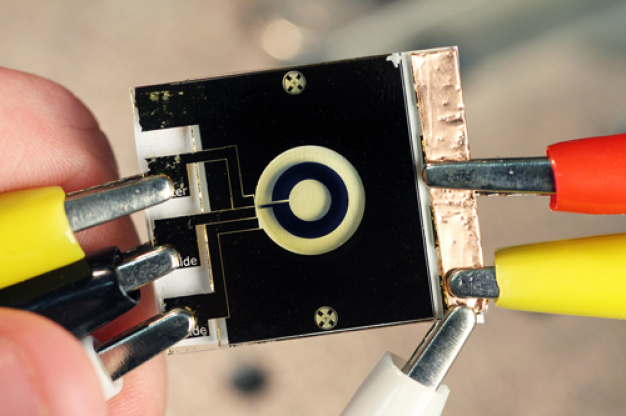
The image shows the new component, an electrochromic iris. It has three aperture levels. In the picture, only the middle level is activated (black ring). Unlike normal mechanical apertures, the middle aperture can be switched without affecting the others. Voltages are applied via the terminals to electrically control each aperture. The black area in the image (besides the ring) is a structured gold electrode layer. (Photo: Koziel/TUK)
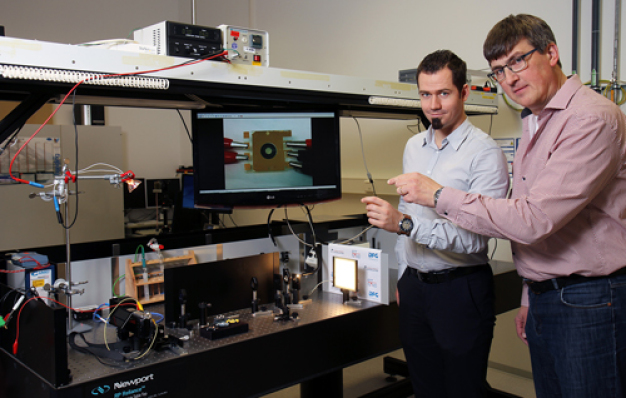
Professor Dr. Egbert Oesterschulze (re.) and his doctoral student Carsten Kortz developed the new filter with partners. (Photo: Koziel/TUK)
Taking a good photo in the midday sun is a challenge even for experienced photographers. An electrically controllable filter, developed by physicists from Kaiserslautern with partners, can help here. The amount of light transmitted is adjusted by setting the color degree. The filter uses electrochromic (EC) molecules on nanoparticles, which change their optical properties in less than a second when an electric voltage is applied. EC filters are the most contrast-rich and fastest components of their kind. They are particularly interesting for micro-optics in smartphones. The researchers present their work in the scientific journal Nature Communications.
The term transmission describes the permeability of a material for optical light waves. Physicists led by Professor Dr. Egbert Oesterschulze, Carsten Kortz, and Alexander Hein from the Technical University of Kaiserslautern (TUK) have developed a novel filter that can change this permeability in less than a second.
“Our technology uses two coordinated electrodes that enhance their coloring as effectively as possible,” says Professor Oesterschulze, who heads the Chair of Physics and Technology of Nanostructures at TUK. The special feature here: nanoparticle layers with specially adapted molecules are on the electrodes. These have very particular properties: they are electrochromic. This means they change their optical properties when a voltage is applied or changed to the electrodes. “One electrode undergoes oxidation, while the other undergoes reduction at the same time,” explains the Kaiserslautern professor. “Electrons migrate from one electrode to the other.” As a result, the molecules on the nanoparticles become colored. This coloring state remains without further energy input and can be completely decolored again by reversing the voltage.
The researchers succeeded in making this electrochemical process for these materials run quickly and at the same time achieve very good color contrast with their filter. “It takes less than a second,” he continues. “This is the fastest that has been achieved so far in this type of component.”
These components, or the materials used, are not only interesting for cameras and smartphone cameras; they could also be used in dimmable window panes. Not only visible light can be filtered out, but also, depending on the material, infrared radiation, which heats the interior of a building especially in summer. Additionally, the presented filters could be used in cameras for security applications, such as monitoring premises. Overexposure due to sunlight can be prevented with these filters.
The Kaiserslautern physicists developed the system together with their colleagues Dr. Marius Ciobanu and Professor Dr. Lorenz Walder from the University of Osnabrück. The work was funded by the German Research Foundation.
The study was published in the renowned journal Nature Communications: “Complementary hybrid electrodes for high contrast electrochromic devices with fast response”. It was also recognized by the journal's editors as a “Editors' Highlight”: https://www.nature.com/collections/dmmhtcypsc/content/jacilynn-brant
DOI: https://doi.org/10.1038/s41467-019-12617-4
Questions answered by:
Prof. Dr. Egbert Oesterschulze
Physics and Technology of Nanostructures
Tel.: 0631 205-2680
Email: oester[at]physik.uni-kl.de
Technische Universität Kaiserslautern
67663 Kaiserslautern
Germany



