




- Translated with AI
Catalysts for medical and biotechnological progress: Are blue-green algae the little superstars of tomorrow?
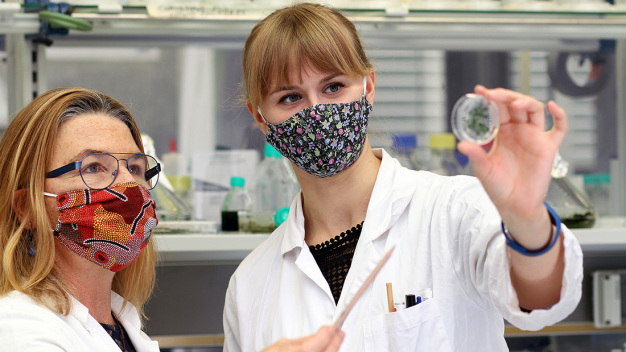
Depicted are Dr. Michelle Gehringer (left) and her master's student Katharina Ebel (right). The photo may be used free of charge for reporting purposes. (Source: TUK/Koziel)
Cyanobacteria are older than humanity and play a central role in Earth's biogeochemical cycles: they fix carbon dioxide and produce oxygen via photosynthesis. A team of researchers from TU Dresden, together with Dr. Michelle Gehringer from TU Kaiserslautern and scientists from Hochschule Kaiserslautern, now aims to demonstrate that blue-green algae still hold even more potential. They decode the genetic material of these microorganisms to find out if and how they can be used as producers of economically and medically valuable compounds. For this purpose, the team has secured one of the coveted sequencing grants from the Joint Genome Institute (JGI), USA.
For the human eye, cyanobacteria become visible, for example, during heat-induced algal blooms on the surface of bathing lakes. In addition, they form visible crusts or colored coatings on rocks or the ground, or live symbiotically within plants. What makes them so valuable in nature: "Blue-green algae colonized the Earth even before plants and played a crucial role in enabling life as we know it to develop," explains Dr. Michelle Gehringer, who leads the Geo- and Environmental Microbiology working group at TU Kaiserslautern. "Thanks to their ability to perform photosynthesis, they triggered the so-called 'oxygen catastrophe.' Suddenly, large amounts of oxygen entered the atmosphere."
Gehringer has been researching cyanobacteria for over 20 years. "During my doctoral studies in South Africa, I already began studying blue-green algae and the secondary metabolites they release," says the scientist, who was born in England. "For example, substances toxic to animals and humans that enter water bodies during algal blooms are well known. My particular interest was in understanding how and under what environmental conditions these organisms produce these so-called secondary metabolites." Since then, the researcher has focused on the biological diversity of cyanobacteria and their ability to adapt to extreme climatic conditions. She has examined numerous strains in nature, cultivated them in the lab, and ultimately brought her "collection" to TU Kaiserslautern.
Using cyanobacteria as 'drug factories'
The ability of cyanobacteria to produce, alongside their essential metabolites, other biologically active substances is now being utilized by Gehringer in collaboration with fellow researchers in the genome project. In the first step, the team decodes the genetic material of a total of 40 cyanobacterial strains to assess their full natural product potential. Using methods from synthetic biology and biotechnology, the obtained information will subsequently be used to specifically discover new active molecules. Ultimately, the goal is to determine how and under what conditions algae can produce useful and economically significant compounds on a large scale. In times of rising antibiotic resistance and viral pandemics, the researchers hope to gain crucial insights for medical progress.
Because Gehringer knows cyanobacteria, or "secret heroes" of Earth's history, better than anyone else, Dr. Paul D’Agostino and Prof. Dr. Tobias Gulder (from the Chair of Technical Biochemistry at TU Dresden and main applicants of the genome project) have brought them into the team. Their task in the project: together with their master's student Katharina Ebel, they prepare one-third of the bacterial strains studied in the project so that the JGI can subsequently determine the DNA sequences. They also research how to design optimal production conditions so that cyanobacteria can reach their full potential.
"This project fits very well with the research priorities of our department," summarizes Gehringer. "A special interface exists with the working group of Prof. Nicole Frankenberg-Dinkel, which, among other things, investigates the pigments responsible for photosynthesis in cyanobacteria. Notably, the red, light-induced 'chlorophyll f,' which ensures that cyanobacteria can still produce oxygen even in the shade."
Questions answered by:
Dr. Michelle Gehringer
Tel.: 0631 205-2199 / 0174 9173561
Email: mgehring@bio.uni-kl.de
Technische Universität Kaiserslautern
67663 Kaiserslautern
Germany