

- Translated with AI
BRIDLE – brilliant diode laser for industry on a record course
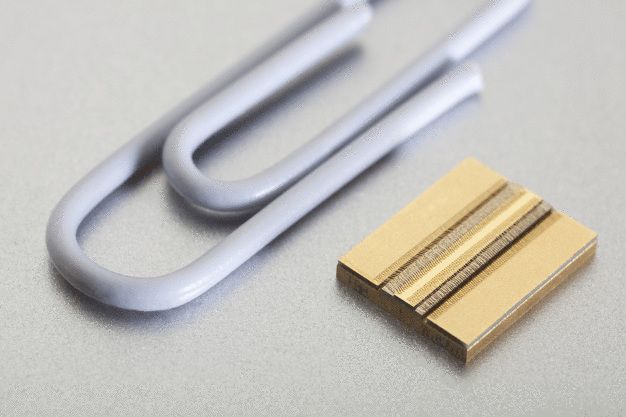
FBH_1010_050_to_BRIDLE
Highly energy-efficient and powerful diode lasers for industry were developed with significant involvement from the Ferdinand-Braun-Institut in the European project BRIDLE. Several records were broken in the process.
The market for industrial lasers is growing rapidly and constantly demands improved beam sources. Until now, reliance was often placed on fiber, solid-state, or carbon dioxide lasers, which achieve the necessary power density and brightness but also consume a lot of energy; they have a maximum efficiency of about 35 to 40%.
The EU-funded BRIDLE project (High Brilliance Diode Lasers for Industrial Applications) has been underway since 2012 to support European industry in this global race to develop compact and highly efficient lasers. Progress was aimed at both semiconductor and optical technologies, for example through the combination of different wavelengths on a single chip (beam combination). "The goal was to deliver maximum power with the highest efficiency into a highly brilliant laser beam," says Dr. Paul Crump from the Ferdinand-Braun-Institut, Leibniz Institute for High-Frequency Technology (FBH). "Diode lasers have the best potential for this because they are the most energy-efficient laser source and thus very environmentally friendly." Such diode lasers are already used today as pump sources for larger lasers. The aim is to directly use small diode lasers for material processing in high-brightness applications such as steel cutting.
BRIDLE project coordinator Thomas Brand spoke of great progress that led to record results in several of the diode laser designs newly developed by Crump's team at FBH. The epitaxial design was improved, and the processing was optimized so that the standard width of 100 micrometers (μm) of the emitting layer could be reduced to 30 μm — without significant compromises in efficiency and power. This allows the brightness of the laser beam to be doubled compared to the previous state of the art, leading to better focusing on a tiny point and significantly improving metal cutting.
FBH also developed new chip structures that enable the beam to be combined efficiently and cost-effectively. For this purpose, a novel monolithic grating was integrated into the high-brightness narrow DFB diode lasers, stabilizing and optimizing the wavelength. This makes it possible, for the first time, to achieve a narrow spectrum (<1 nm), high power (5 W), and high efficiency (50%) simultaneously in a brilliant beam. Additionally, multiple laser strips with closely spaced, stepped wavelengths were integrated onto a single chip. Such sources are particularly advantageous for spectral beam combination and power scaling in material processing systems.
Another approach was based on diode lasers with internal trapezoidal beam filters. They already achieve particularly high brightness today. Their conversion efficiency was significantly improved by BRIDLE from about 30% to over 40%. However, this is still not enough for industrial material processing. Furthermore, the technical effort for beam bundling is somewhat higher. Despite these obstacles, significant progress was made in fundamental research on novel approaches to brilliant coherent beam combination in trapezoidal lasers, which will be further advanced in cooperation between FBH, LCFIO, and ILT. Crump and his colleagues are convinced that further improvements in efficiency and performance of trapezoidal lasers are possible.
"Since European countries pay higher wages than, for example, in Asia, we have also considered cost-effective series production from the beginning," says Crump. "We have also gained very valuable insights in this area."
Especially in metal processing — welding, cutting, or drilling — the industry hopes for highly brilliant and powerful diode lasers, as they enable particularly environmentally friendly, compact systems. So far, industrial lasers produce the beam inefficiently in large, complex cooling systems, from which the beam must be transmitted via glass fiber cables to the workpiece. With the diode lasers developed in the BRIDLE project, the important brightness for industry is now achieved. A laser is considered brilliant if its beam can be focused over a distance of one meter onto a tiny point of just 0.1 millimeters. The BRIDLE partners demonstrated with a 1-kW laser head that direct steel cutting is possible. Such systems are particularly suitable for compact and energy-efficient laser modules.
Diode lasers convert energy into light more efficiently than any other system. They are also inexpensive in mass production because thousands are processed on a wafer and can be integrated into small, highly reliable modules. "We are working to further improve the excellent results of BRIDLE — for quick transfer to industry," says Crump. The diode lasers developed at FBH provide a technological advantage that is crucial for the global market.
Ferdinand-Braun-Institut gGmbH
12489 Berlin
Germany