




- Translated with AI
Bioplastics Polylactic Acid – More Toughness Through Addition of Gluten
Joint project "GLUPLAST" successfully completed at KUZ
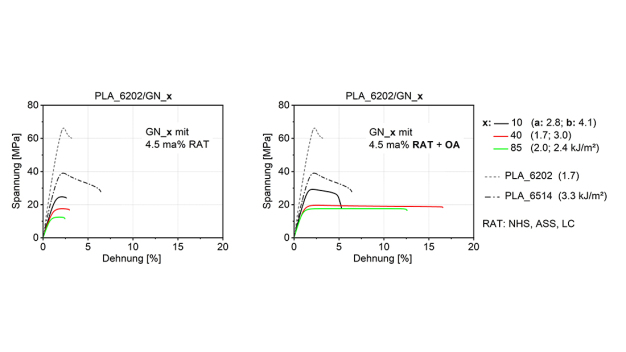
Fig. 1: Stress-strain diagrams for PLA_6202 blends with 40 wt% GN_10, GN_40, and GN_85; left: with 4.5 wt% RAT, right: with 4.5 wt% RAT as well as OA
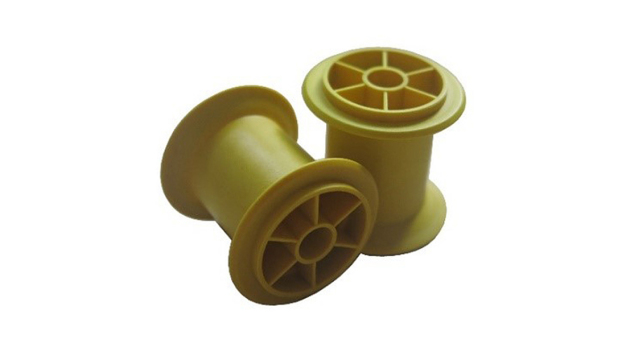
Fig. 2: Sprayed-injected yarn spools (yellow dyed) from PLA_6202/GN_40 (60/40 w/w)
Polylactic acid (PLA) is a polyester produced through a multi-stage process from sugar. In this process, sugar is fermented into lactic acid and then polymerized into PLA. The bio-based and biodegradable plastic PLA has a very high strength of up to 70 MPa as well as an extremely high stiffness of up to 6 GPa, but without appropriate additives, it is brittle, which greatly limits its potential applications. Current measures to increase the plastic deformability and thus toughness mainly involve blending PLA with elastic, degradation-resistant polymers based on petrochemical raw materials, such as thermoplastic polyurethanes or ethylene copolymers.
Within the framework of the funded joint project GLUPLAST by the BMWi, KUZ together with the industry partner CompraXX GmbH succeeded in using the natural substance wheat gluten to achieve a impact toughness modification of the bioplastic PLA. The project aimed to utilize the crosslinking tendency of gluten during heat treatment to create a crosslinked elastomeric phase, which, after blending using a twin-screw extruder, is finely distributed within the PLA matrix and, with proper adhesion, leads to a significant increase in the toughness of the base material PLA.
Influence on Gluten Crosslinking
Gluten crosslinking begins at around 80°C. Gluten-containing PLA blends, processed at 160°C, initially showed an insufficient degree of fragmentation of the gluten phase, which hindered the intensive and rapid temperature-induced crosslinking, resulting in a significant reduction in phase size and fine distribution. Here, the elongation at break (about 1.4%) and Charpy impact strength (about 1.5 kJ/m²) were clearly below the PLA level.
To achieve a finer distribution of the gluten phase within the PLA matrix, KUZ pursued two approaches:
1. Temporary suppression of crosslinking through the addition of chemical additives,
2. Reduction of crosslinking by diluting wheat gluten with flour.
Materials for the Production of Gluten-Containing Polymer Blends
Materials used:
1. Bioplastics:
PLA Ingeo 6202D, PLA Ingeo 3001D, PLA-Blend Bioflex 6514 (reference),
2. Gluten-Containing Natural Substances (GN):
Wheat gluten (protein content approx. 85 wt%, GN_85), wheat flour (GN_10), gluten-flour mixture (GN_40),
3. Plasticizer:
Glycerin (GL),
4. Adhesion Promoter (and Viscosity Reducer):
Oxalic acid (OA),
5. Reducing agent, antioxidant, trapping reagent (RAT):
Sodium hydrogensulfite (NHS), acetylsalicylic acid (ASA), L-cysteine (LC).
Positive Influence on Material Mechanics
The impact toughness modification of polylactic acid (PLA) using gluten-containing natural substances (GN), as targeted in the GLUPLAST project, was successfully achieved. For modification, PLA with a fracture strain of approx. 3.5% and Charpy impact strength of about 2 kJ/m² was selected. Adding GN to PLA positively influenced the elongation (up to 30%) and impact strength (4 kJ/m²). These values were significantly above the PLA baseline. Similarly, blend mechanics showed a strong dependence on the protein content of the GN phase (see Figure 1).
A finer distribution of GN within the PLA matrix was achieved by lowering the protein content of GN and by adding chemical additives (RAT), such as sodium hydrogensulfite, L-cysteine, and acetylsalicylic acid. A marked improvement in phase adhesion and thus in PLA blend mechanics was realized by adding oxalic acid to GN. The gluten content in the blend was preferably 40 wt%. The material mechanics achieved in the project are positively evaluated by the partners.
Successful Material Testing in the Injection Molding Process
The gluten blends can be processed in injection molding without issues, see Figure 2. The browning of the material caused by the Maillard reaction, which increases with higher protein content of the natural phase, can be masked by adding color batches.
The commercialization of the research results is pursued by the industry partner CompraXX GmbH. During the project, CompraXX GmbH successfully transferred the results from laboratory to pilot scale. The combination of PLA with wheat gluten yields interesting material properties, enabling exciting applications in the fields of household and office items.
Kunststoff-Zentrum in Leipzig gGmbH
04229 Leipzig
Germany