

- Battery
- Translated with AI
Battery research: Start of the first fully automated laboratory
A new high-tech research facility at the POLiS Excellence Cluster accelerates battery development – Visit of the Minister of Science at the launch
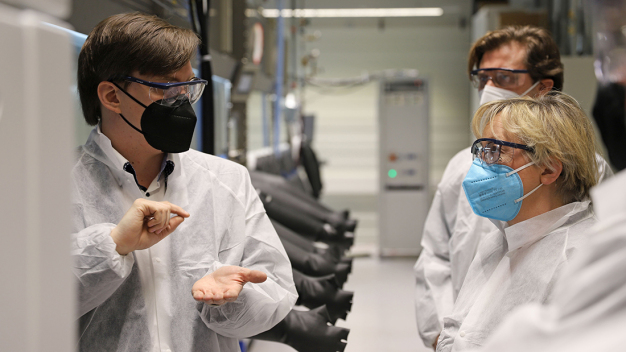
Professor Helge Stein explains Minister Theresia Bauer a part of the new material acceleration platform. (Photo: Daniel Messling, KIT)
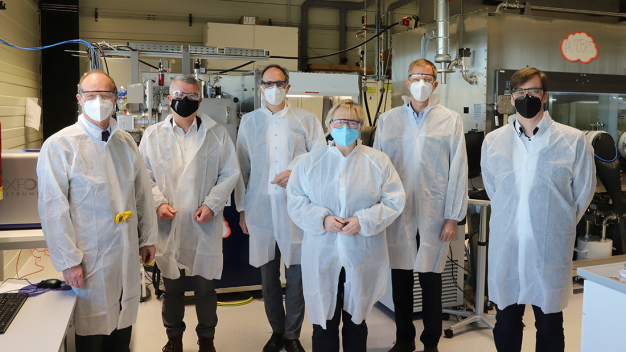
Start of the new high-tech facility: Professor Michael Weber, President of the University of Ulm, Professor Maximilian Fichtner, Professor Joachim Ankerhold, Vice President of the University of Ulm, Minister Theresia Bauer, Professor Oliver Kraft, Vice President of KIT for Research, as well as Tenure-Track Professor Helge Stein. (from left to right; Photo: Daniel Messling, KIT)
Around-the-clock battery assembly, analysis of thousands of interfaces, autonomous evaluation of results using Artificial Intelligence (AI), and immediate planning of the next experiment: a new facility at the Excellence Cluster POLiS automates and digitizes material development. The autonomous research laboratory was created through a collaboration between the Karlsruhe Institute of Technology (KIT), the University of Ulm, and the Helmholtz Institute Ulm (HIU), and is now operational. Baden-Württemberg's Minister of Science, Theresia Bauer, was present at the launch.
For the transportation and energy transition, innovative high-performance and sustainable batteries are needed. This presents a major challenge, as it currently takes decades from idea to finished product with existing methods. With a newly completed high-tech facility at POLiS, this process is expected to become much faster in the future. The flagship project was developed within the Excellence Cluster POLiS, where KIT works together with the University of Ulm on the batteries of the future. "With the funding of this new material development platform, a unique research infrastructure has been created worldwide. We hope for a significant boost in research on energy storage, which is essential for the transition of our energy system and mobility. At the same time, with this funding, we were able to attract Professor Helge Stein as a creative and energetic leader for our team in Ulm," says Theresia Bauer, Minister for Science, Research, and the Arts in Baden-Württemberg, who visited POLiS and HIU on the occasion of the launch.
World's first fully integrated platform for accelerated research in electrochemical energy storage
Helge Stein, Tenure-Track Professor at KIT and head of the POLiS research area, explains the advantages of the facility: "We are now able to automate the synthesis and assembly of batteries and their individual components, initiate measurements, and evaluate them fully automatically. Based on the data, the AI-supported system can even decide which experiment to perform next." With his research group, Stein has developed the underlying combinatorial materials synthesis, high-throughput characterization, and data mining techniques using AI methods for experiment evaluation and planning. The facility, named PLACES/R (Platform for Accelerated Electrochemical Energy Storage Research), represents the world's first fully integrated platform for accelerated research in electrochemical energy storage.
New paradigm for battery material development
Battery research is characterized by the search for the ideal combination of materials, their composition, and processing techniques. Testing all possible variations with all materials would take millennia using traditional methods. "Our facility can test several hundred such variations per day. This is roughly equivalent to the average lifetime work of a researcher," says Stein. In addition to acceleration through automation, algorithms and AI enable a tenfold faster optimization, allowing promising battery concepts to reach market readiness even more quickly and cost-effectively.
The new research facility is embedded within a European framework: the data collected across all stages of battery development are shared with 34 institutions from 15 countries through the BIG-MAP project of the European research initiative BATTERY2030+. "The fully automated laboratory will not only enable us and our European partners to develop components for new batteries much faster. It will also ensure that batteries can be produced at such low costs that storing electricity from sources like sun and wind will become even more attractive in the future," says Professor Maximilian Fichtner, Managing Director of HIU and spokesperson for POLiS.
Karlsruher Institut für Technologie
76131 Karlsruhe
Germany