




- Translated with AI
Avoidance of moisture-related defects in molded parts – Moisture, Rheology, and Part Properties
Development of action guidelines for plastic processors to ensure consistently high quality of technical parts during injection molding
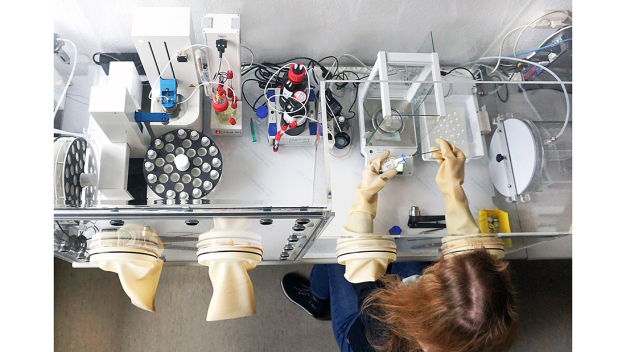
Fig. Sample preparation and measurement in the glovebox at KUZ
When producing high-quality injection-molded parts from polyamides, the moisture content of the processed granulate plays a significant role. Variations in the quality of the molded parts can usually only be avoided through process-related control of the granulate's moisture content. This is highly relevant because moisture can vary greatly with each material batch. To compensate for this, the material is dried—preferably slightly longer than too short. Another problem is the different measurement methods used to determine the moisture or water content of plastics. These methods differ significantly in their measurement principles and accuracy, making the results mostly not comparable. Especially for measuring low water contents of <0.1%, only a few methods are suitable.
In a research project at the Plastics Center in Leipzig (KUZ), the relationship between granulate moisture, rheology, and part properties is being investigated. At the same time, the reliability of various moisture measurement methods is being examined. The goal of the project is to develop guidelines for plastic processors to achieve consistently high part quality when injection molding technical parts from PA6 and to minimize scrap.
At the accredited testing laboratory, KUZ has been working for many years on determining water content using Karl Fischer titration (KFT), especially for low water contents (<0.1%). In preparation for the project, the measurement device at KUZ was renewed, and a measurement system with an automatic sample changer from ECH Elektrochemie Halle GmbH was acquired. To improve the accuracy and reproducibility of the KFT, it was enclosed in a glovebox where sample preparation and measurement take place.
In addition to KFT, three other methods are used to determine water content to allow a comparison of measurement techniques. The rheological aspect is examined through tests with the injection molding rheometer developed at KUZ. Additionally, spot measurements are performed with an extrusion rheometer, and the viscosity number and MVR value are determined. An additional focus is on the pre-drying of the granulate. During the project, drying conditions are varied to assess their influence on process moisture and melt viscosity. The project results will be particularly interesting for plastic processors who handle polyamides and want to optimize their process chain.
Duration: 01/2020 - 06/2022, Funding body: BMWi, Project ID: 49MF190136
Contact person: Janine Dubiel, Tel. 0341 4941810, dubiel@kuz-leipzig.de
Kunststoff-Zentrum in Leipzig gGmbH
04229 Leipzig
Germany