




- Translated with AI
Automated production of cell therapeutics for the treatment of osteoarthritis
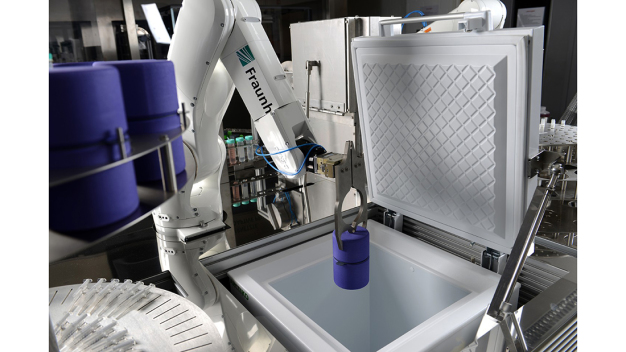
Automatically controlled 6-axis robots transport cells and materials within the systems. With specially shaped grippers, objects of various shapes and sizes can be moved. (© Fraunhofer IPT)
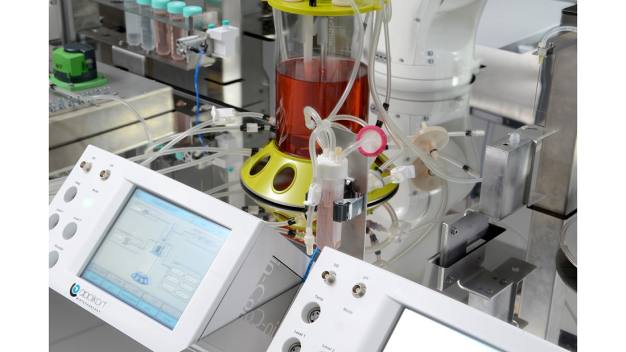
In the bioreactors, the cells are multiplied multiple times. They are harvested as soon as the desired cell number is reached. The control of temperature and gas composition, as well as cell counting and harvesting, are fully automated. (© Fraunhofer IPT)
Osteoarthritis and other serious diseases can be successfully treated in the future with cell therapeutics if it is possible to produce the starting materials for the new drugs and active substances on a large scale at low cost. To this end, an international research team is developing a fully automated manufacturing platform within the EU project "AutoCRAT" over the next four years, which will enable the industrial production of cartilage and stem cells for arthritis treatment. The European Union is funding this promising research project, led by Ireland's National University of Ireland Galway, with a grant of 7.45 million euros; the Fraunhofer Institute for Production Technology IPT from Aachen is responsible as a central partner for the implementation and further development of the plant technology.
For the production of the cells, the project partners rely on fully automated robot-assisted laboratory systems. This is intended to ensure that the active substances from the cell products can be obtained cost-effectively and with consistent quality without elaborate manual laboratory processes. The therapeutics are based on proteins, RNA, and biological nanoparticles derived from stem cells, called extracellular vesicles, which have already proven effective in the treatment of osteoarthritis. The AutoCRAT factory accelerates the development and increases the availability of the cell therapeutics derived from it, so they can be provided to chronically ill patients more quickly and at lower costs.
Today, cell therapies are already being tested for a wide range of diseases, including degenerative diseases, immune and inflammatory reactions, as well as cancer. Depending on the treatment approach, various cell types are used: from stem cells to adult cells from the patient's own tissue to cells of the immune system. However, the use of living cells as medicines requires complex production processes. Their manufacturing processes are currently still relatively inefficient and can only be carried out by highly qualified biotechnologists in cleanroom environments. Clinical studies are increasingly demonstrating powerful treatment options for patients, but without laboratory automation, the availability of therapeutics would fall behind the future high demand.
By fully automating the previously largely manual laboratory processes, the research partners in the AutoCRAT project aim to facilitate the therapeutic use of stem cells: the project initially focuses on developing an effective treatment for osteoarthritis, but will also lay the groundwork for other cell-based therapies.
The international research project is led by Ireland's National University of Ireland Galway. NUI Galway and the Fraunhofer IPT already have joint successes from the recently completed EU project "AUTOSTEM": In an interdisciplinary consortium with medical professionals, biotechnologists, and production engineers, they developed an initial fully automatic and closed robotic platform for the production of cell products. The AUTOSTEM concept is now being further expanded to produce a broader range of cell types and derived products. The AutoCRAT system will feature both automated decontamination and quality control, enabling end-to-end automation of the production process.
Tasks of the partners in the consortium
- The National University of Ireland, Galway, in Dublin, leads the AutoCRAT project as consortium leader.
- The Fraunhofer Institute for Production Technology IPT from Aachen develops the plant technology for the project and contributes its expertise in laboratory automation.
- Valitacell Ltd (VC), based in Dublin, develops automated quality control tests for the production platform.
- The University of Gothenburg and the Medical Center of Leiden University jointly develop and test new arthritis therapies with REMEDI.
- The University Hospital Essen and the University of Genoa develop methods to produce cell-free therapeutic products from extracellular vesicles in the automated plant.
- The Dutch Panaxea BV determines the costs for manufacturing and delivering the developed therapies and assesses the benefits of an effective cell therapy for osteoarthritis for patients and their families, as well as for the European and global economy.
- Pintail Ltd. from Ireland supports project management and dissemination of the project results.
This project was funded under Grant Agreement No. 874671 from the European Union's Horizon 2020 research and innovation program.
The material presented here and the views expressed are solely those of the authors. The EU Commission assumes no responsibility for the use of the information provided here.
Fraunhofer-Institut für Produktionstechnologie IPT
52074 Aachen
Germany