

- mobility of the future
- Translated with AI
Assembly of battery cells – digital and secure
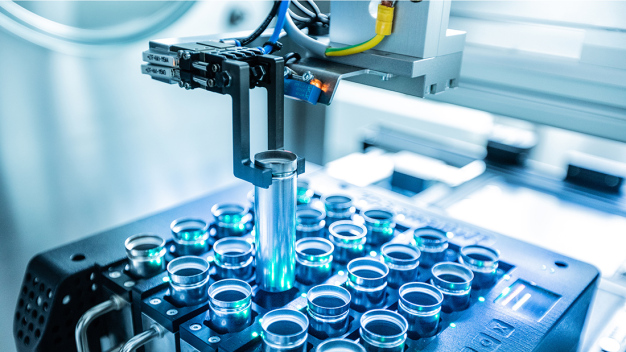
Assembly of battery cells with an intelligent workpiece carrier for digitalized production. © Fraunhofer IPA / Photo: Rainer Bez
The core component of every electric car is the battery. It should be compact and as powerful as possible – and above all, safe. This places high demands on manufacturing. Researchers from the Fraunhofer IPA at the Center for Digitalized Battery Cell Production (ZDB) demonstrate what this could look like in the future.
A modern battery system connects multiple battery modules, each containing a variety of battery cells. Depending on the manufacturer, these cells have different formats. The pilot plant at the ZDB at the Fraunhofer Institute for Production Technology and Automation IPA in Stuttgart is designed for cylindrical cell formats.
Inside a battery cell are the electrodes. They consist of ultra-thin coated foils, which are rolled together with a separator into a winding called a "Jelly Roll." Even a small defect or a speck of dust that enters the interior can significantly weaken performance or even cause a short circuit and thus a fire. Therefore, at Fraunhofer IPA, a laboratory with special clean and dry room conditions was established, supported by funding from the state of Baden-Württemberg. It is equipped with technology that allows complete assembly of battery cells. What makes it special is the digitalization and networking of all process steps. This provides researchers with a manufacturing line unique in Europe, enabling them to support both potential cell manufacturers and machine and plant builders in developing and automating processes, as well as optimizing assembly for reliability and throughput. The scope ranges from analyzing and investigating critical process steps to applying digital tools and building prototypes.
Process monitoring for an optimal solution
About a dozen steps are necessary until a cell is ready for use, and each of these steps is crucial for its quality and for the entire battery system. The process begins with coating the positive and negative electrodes, which are then rolled together with a separator into a "Jelly Roll." Next comes assembly, where the Jelly Roll must be guided with high precision and as contactless as possible with the beaker wall. Then, the winding is welded to the bottom of the beaker via a rod electrode inserted through the central hole of the winding. To prevent shifting or loosening, a ring-shaped indentation, a specific fold in shape and depth, is made at a defined point.
The subsequent step, filling with liquid electrolyte, is particularly delicate and requires an environment free of oxygen and with minimal humidity. The necessary equipment is therefore housed in a hermetically sealed box, a so-called "glovebox," where handling is done from outside with integrated gloves. "In the process conducted under an argon atmosphere, a precisely defined amount of liquid electrolyte must be filled in without overflow, as this affects the cell's performance and lifespan," explains Matthias Burgard from Fraunhofer IPA. This is especially challenging because the liquid seeps in slowly due to the tight pore spaces.
Finally, a cover element with a defined clamping force is inserted, fixed by reshaping the beaker edge, thus sealing the cell. Due to the high reliability required, no safety-critical electrolyte should be present on the outside, but the assembled cell is still cleaned before completion. The process concludes with wrapping the cell in a protective sleeve and labeling.
Knowledge from production data converging in the cloud – new insights emerge
To minimize scrap and improve quality, researchers Florian Maier and Ozan Yesilyurt from Fraunhofer IPA have digitized and networked the entire production process. The manufacturing process is essentially transparent. Numerous sensors on all devices collect data that flows into the cloud in real time. Traceability technologies developed at Fraunhofer IPA enable the collected data to be assigned to the produced battery cells. The key point: each individual battery cell produced is represented as a digital twin for data analysis and training artificial intelligence. This allows tracing back the conditions under which it was manufactured and how it relates to the achieved product quality. Researchers like Soumya Singh orchestrate this data and use it to develop services with monitoring, analysis, and prediction capabilities. This makes it possible to continually optimize the production process and identify sources of errors faster than before.
Furthermore, the data collected during production also helps develop better predictive models for the aging behavior of battery cells during use, evaluate additional applications for used battery cells, and improve recycling processes. The involved scientists are currently compiling other approaches to digitize and data-driven optimize battery production in the book "Handbook on Smart Battery Cell Manufacturing," which is scheduled to be published later this year.

Fraunhofer-Institut für Produktionstechnik und Automatisierung IPA
Nobelstraße 12
70569 Stuttgart
Germany
Phone: +49 711 970 1667
email: joerg-dieter.walz@ipa.fraunhofer.de
Internet: http://www.ipa.fraunhofer.de