




- Translated with AI
Artificial intestine aims to limit animal testing
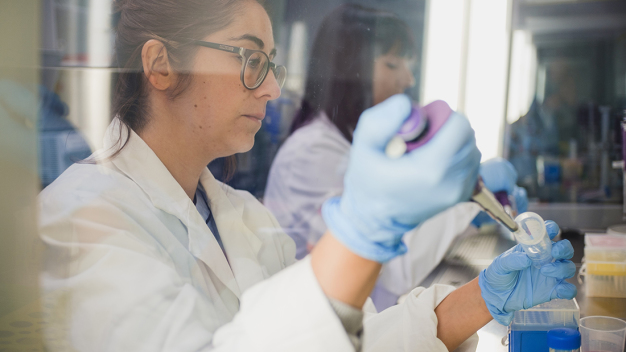
In the laboratory, the cells are prepared. (HSKL/Lukas Mohr)
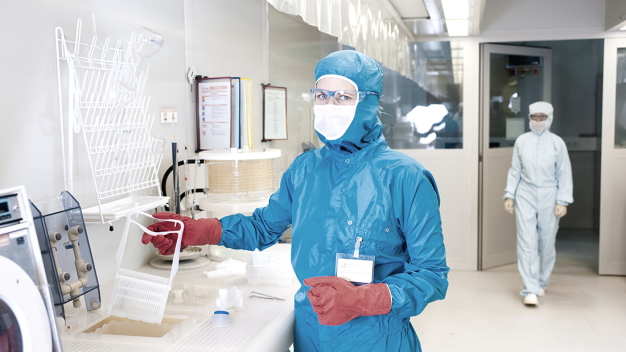
Indispensable for the researchers is the well-equipped cleanroom at the Zweibrücken site. (HSKL/Rainer Lilischkis)
Animal testing is often indispensable when it comes to medical research. If it were possible to cultivate fully functional organs in the laboratory, tests on living organisms could be significantly reduced or even completely avoided. This approach is pursued by the project "Tissue Engineering of Tissues in Complex Hydrogels Using Three-Dimensional Electrical and Magnetic Stimulation" at Kaiserslautern University of Applied Sciences. The researchers receive funding of one million euros from the Carl Zeiss Foundation.
Reconstructing (tissue engineering or tissue cultivation) fully functional complex tissues and organs is a challenge in regenerative medicine. With 3D printing techniques, it is already possible to generate structures that at least morphologically resemble those of organs. Today, cells and biomaterials can already be combined and printed layer by layer to produce biomedical parts that have the same properties as natural tissue. However, the printing process subjects the cells to enormous stress; many do not survive the procedure. "In our project, we pursue a gentler approach that specifically influences cell growth under the effect of magnetic and electric fields," explains Prof. Monika Saumer from the Zweibrücken campus of Kaiserslautern University of Applied Sciences, who is involved in the highly interdisciplinary project along with a total of nine working groups. The researchers will develop a micro-electro-mechanical system (MEMS) that, through the combination of micro- and nanostructures, can generate complex three-dimensional static and alternating fields of different strengths and influence the cells.
"We introduce a hydrogel, a gel-like product similar to gelatin, with living cells into a container. The electric and magnetic fields we use for controlling cell growth also occur in nature. Our goal is for the deployed nerve and muscle cells, or their precursor cells, to be histologically correctly oriented and to grow together into a functional tissue unit," says Prof. Saumer. "From literature and our own work, we know the order of magnitude of electric and magnetic fields that affect cell growth. Now, we need to find the ideal combination of signal strength and frequency." In the end, a functional piece of intestine should be created. The intestinal tissue can then be used for drug testing or for researching the effects of nutrients. Animal testing is thus reduced or even rendered unnecessary. "We might be able to reach a point in five years where initial drug tests are possible," notes Prof. Saumer. Two companies from the pharmaceutical sector are already involved in the project. Also, the use of the intestine as a replacement tissue for a diseased or missing section of the human intestine could be possible in the longer term, according to Saumer.
The project at Kaiserslautern University of Applied Sciences will start on April 1, with a total of five new employees being hired. In addition to the funding from the Carl Zeiss Foundation, Kaiserslautern University of Applied Sciences is supporting the project with 150,000 euros. The funding period is three years.
About the Carl Zeiss Foundation
The Carl Zeiss Foundation aims to create space for scientific breakthroughs. As a partner of excellent science, it supports both fundamental research and application-oriented research and teaching in the STEM fields (Mathematics, Informatics, Natural Sciences, and Technology). Founded in 1889 by physicist and mathematician Ernst Abbe, the Carl Zeiss Foundation is the oldest private science funding foundation in Germany. It is the sole owner of Carl Zeiss AG and SCHOTT AG. Its projects are financed from the dividend distributions of the two foundation companies.
Technische Universität Kaiserslautern
67663 Kaiserslautern
Germany



