- R+D & Community of Interest
- Translated with AI
Artificial Intelligence for Medical Technology
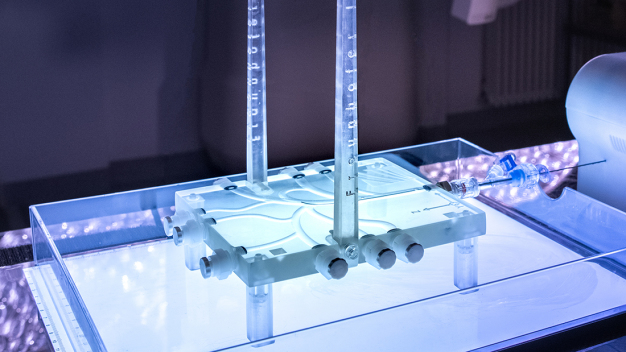
Printed vessel phantom with inserted guide wire for a catheter. (Source: Fraunhofer IPA; Photo: Vanessa Stachel)
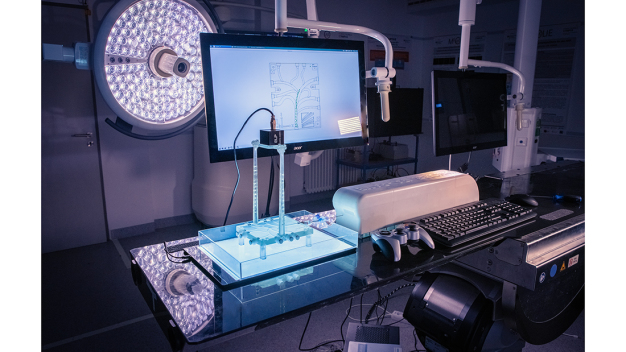
Setup for training and validating an AI for the autonomous navigation of a guidewire. (Source: Fraunhofer IPA; Photo: Vanessa Stachel)
Medium-sized medical technology companies in Baden-Württemberg are soon expected to utilize methods of artificial intelligence (AI) for the further development or new development of their products. The know-how is provided by the project group for automation in medicine and biotechnology PAMB of the Fraunhofer IPA and the University Medical Center Mannheim in the Application Center for Intelligent Machines in Medical Technology (ANIMMED). As part of the Baden-Württemberg Health Location Forum, the state promotes ANIMMED and seven other projects with a total of 13.9 million euros.
With methods of artificial intelligence (AI or AI – Artificial Intelligence), machines can automatically analyze, decide, or control in complex situations. These properties make AI systems particularly relevant for use in medicine: intelligent methods already enable the analysis of vast amounts of data in diagnostics in practice, which a human can no longer manage.
Medical devices can also be automated through the use of intelligent methods. Thus, devices can make clinical applications significantly more efficient and support doctors more effectively. However, without the use of AI, automation of medical devices in most clinical applications seems hardly possible today. The reason lies in the natural diversity of the human organism, its vulnerability, and the complex biology of the human body. Humans master this complexity and variability. They make partial decisions and regulate elements in the medical process, but their resources can be significantly expanded with the help of intelligent machines. Automation through AI systems is therefore currently regarded as a technical key for future efficient precision medicine.
Despite these expectations, apart from a few diagnostic areas, such as radiology and dermatology, only isolated, limited AI applications are ready for use in clinical practice. The possibilities of AI for controlling medical technology devices and instruments remain largely untapped in clinical practice today.
The prerequisites for implementing AI solutions in medical technology are already in place. AI software libraries and algorithms, sufficient storage capacity, and the necessary computing power are already available. Additionally, powerful measurement technology and affordable computer technology, along with new materials, drive concepts, and new clinical approaches, could enable intelligent machines in the form of devices or instruments for medicine.
Advantages of AI in medical technology
Various projects of the Mannheim project group have shown that AI is a key technology for intelligent control of machines, i.e., instruments, devices, or systems such as robots, in clinics. With the help of AI, machines can support doctors in the future even in critical tasks and the control of complex processes in clinics by automatically taking over processes and relieving staff as needed. This makes it possible to optimally tailor processes of care, diagnosis, and intervention to the individual situation of the patient while maintaining efficiency. Despite additional costs for the necessary digital infrastructure, medical care will remain affordable in the future.
Training data is crucial
A key point for AI application in medical devices is access to training data. Because learnable AI systems for intelligent devices and instruments should be trained with large amounts of data that are valid. This means the data accurately represent reality and are verifiable concerning the calculated result. Especially for medical technology applications, such large data sets can only be obtained in clinical everyday practice or in highly realistic scenarios and simulations. This requirement is a major obstacle in most cases for the development of AI systems in medicine. The effort for companies becomes too great. This creates a vicious circle: because tangible applications are missing, the feasibility and benefits of AI solutions cannot currently be demonstrated through practical examples to a sufficient extent. As a result, the development of applications progresses only slowly.
Best-practice demonstrators and clinical development methods
ANIMMED breaks this vicious circle through best-practice demonstrators and the offering of clinical development methods: using three demonstrators for medical technology AI systems, ANIMMED evaluates its own AI development methodology and simultaneously uses the results as reference projects. The close network of partners and their location on the campus of the University Medical Center Mannheim (UMM) provides an optimal ecosystem: the medical professionals and facilities of UMM, the Heinrich-Lanz Center (HLZ) as a specialist for data collection from clinical sources, and the Fraunhofer project group for automation in medicine and biotechnology PAMB with its experience as an AI application developer and operator of the Mannheim Medical Transfer Center M2TC form an established, interconnected structure that provides the foundation for efficient project execution.
Application Center for Intelligent Machines in Medical Technology (ANIMMED)
The establishment of the development and application center within the existing facilities of the Fraunhofer project group and the HLZ promotes the use of AI for medical technology. Located on the grounds of the University Medical Center Mannheim, ANIMMED supports medical technology companies in developing, training, and adapting AI solutions for intelligent medical devices and instruments.
13.9 million euros for the health location Baden-Württemberg
Besides the Application Center for Intelligent Machines in Medical Technology, the Ministry of Economic Affairs is funding seven additional projects with a total of 13.9 million euros. After the Ministerial Council approved the funding within the framework of the Baden-Württemberg Health Location Forum on April 21, Baden-Württemberg's Minister of Economic Affairs, Dr. Nicole Hoffmeister-Kraut, justified the decision: "Innovative ideas and projects are the key to a high-performance healthcare industry in the state. Especially in times of crisis, it is essential to continuously develop and secure these competencies for the future. With the first eight projects, we will significantly advance these key technologies – for the benefit of patients and the economic location of Baden-Württemberg."

Fraunhofer-Institut für Produktionstechnik und Automatisierung IPA
Nobelstraße 12
70569 Stuttgart
Germany
Phone: +49 711 970 1667
email: joerg-dieter.walz@ipa.fraunhofer.de
Internet: http://www.ipa.fraunhofer.de