- Trade fair
- Translated with AI
Arburg: Machine and Application Highlights for Medical Technology
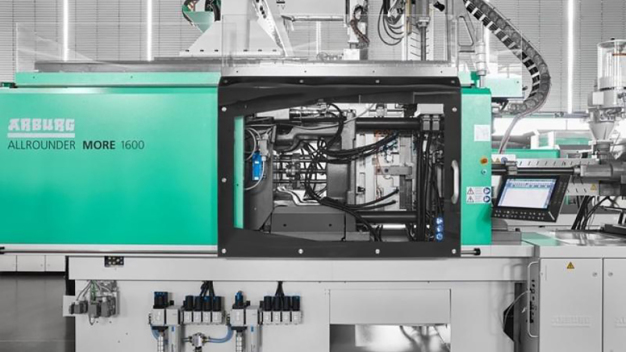
The enlarged installation space of the all-rounder More offers more room, according to the manufacturer, also for larger multi-component tools, and a comfortable tool change. (Image: Arburg).
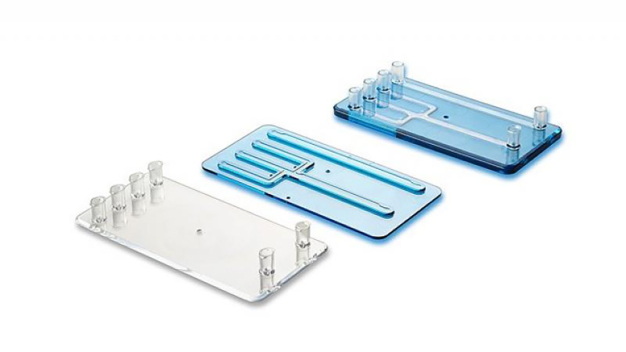
The all-rounder More is also suitable for demanding multi-component injection molding, such as "Lab-on-a-Chip" made from two transparent PC materials. (Image: Arburg).
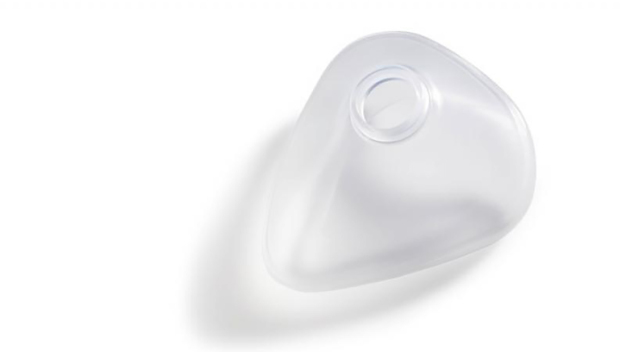
At Fakuma 2021, an electric all-rounder produced the flexible LSR injection-molded parts of mouth-nose masks, which were removed by a robot system Multilift Select. (Image: Arburg).
Arburg showcased three demanding applications for medical technology at Fakuma 2021: A two-component machine from the new Allrounder More series produced ready-to-use "Lab-on-a-Chip" in assembly injection molding – including multiple testing stations. How machine and tool will communicate in the future was demonstrated by a hybrid "Packaging" Allrounder in cleanroom design manufacturing transparent blood tubes. Additionally, the efficient production of LSR masks was demonstrated, with the dosing system and robot system digitally connected to the machine.
The multi-component injection molding with innovative machine and tool technology opens up new application fields. For example, assembly injection molding can eliminate downstream steps such as assembly, ultrasonic welding, or bonding. Digitalization allows integration of LSR dosing systems and creation of new interfaces to the tool. According to the manufacturer, this offers significant added value in the manufacturing of medical products.
Hybrid Allrounder for mass-produced medical articles
Using the example of transparent, shatterproof PET blood tubes, Arburg demonstrated efficient and high-quality manufacturing of mass-produced medical devices at Fakuma 2021. A hybrid Allrounder 630 H "Packaging" with 2,300 kN clamping force in cleanroom design was used. A clean air module with ionization ensured low-particle air in the work area, while the increased machine height enabled optimal cleaning. The high-performance machine was equipped with a 32-cavity tool from partner Hack. The cycle time was approximately 6.5 seconds, with a shot weight of 227 grams. This resulted in a high throughput of about 27 kilograms or 17,700 blood tubes per hour.
New interface between machine and tool
A novelty in this application was the communication between the tool and the machine, developed by Arburg together with the tool partner Hack. The exhibit's tool integrated two cameras capable of capturing images or videos of tool separation and part ejection, as well as four position sensors. Additionally, four impact sensors were installed for the column guides. This allows monitoring of tool breathing and deviations in position during closing or separation. During the trade show, data was collected via a digital box on the tool and transmitted via OPC UA to the Allrounder. This enabled the machine control to display, for example, performance-dependent maintenance intervals for the tool.
2K machine: Allrounder More produces "Lab-on-a-Chip"
The Allrounder More series celebrated its trade fair premiere. The exhibit, with 1,600 kN clamping force, produced in assembly injection molding and with two injection programs in a single step, ready-to-use "Lab-on-a-Chip" from transparent PC. No post-assembly or bonding was necessary. For this demanding medical application, the machine was equipped with an innovative 2+2 cavity tool from Weber. Using the vertical injection unit of size 170, two half-shells with delicate fluidic contours (200 micrometers) were first injection-molded, while simultaneously, the corresponding second halves were produced with the horizontal injection unit of size 400. Instead of using a robot system, the tool was rotated 90 degrees, positioning the two injection parts on the die side and directly joining them.
In the second injection program, a core was molded using a needle valve nozzle via the vertical injection unit, filling the cavity between the two components. This bonded the two halves and sealed the fluid channels. As a result, a complete, leak-proof "Lab-on-a-Chip" made of transparent PC, including connectors for fluid supply such as Luer-Lock or Luer-Slip threads, was produced in about 45 seconds total cycle time.
A vertical robot system, Multilift V 30, removed the transparent two-component parts and transferred them to a rotary indexing table. There, during 100% inspection, each "Lab-on-a-Chip" was visually and pneumatically checked at four stations for geometry, channel depth and width, leak tightness, and contamination. Finally, the Multilift V 30 placed the OK parts onto a conveyor belt.
LSR processing: Multifunctional mouth-nose mask
Last year, Arburg implemented a challenging COVID-19 project: manufacturing multifunctional mouth and nose masks from LSR and PP, which can be sterilized easily and reused multiple times. Development from prototype to series readiness took only 41 days. The application was developed in cooperation with well-known manufacturers of tools (Polarform), dosing systems (Elmet), and materials (Wacker).
An electric Allrounder 570 E Golden Electric with 2,000 kN clamping force produces four soft LSR masks in a 55-second cycle, which are molded over the nose and mouth. The dosing system is integrated into the Allrounder control via OPC UA (Euromap 82.3), allowing centralized parameter adjustments, retrieval of dosing data, and saving of the data set. It is perfectly matched to the tool. Relevant input parameters such as material pressure, color and additive settings, and remaining cycle times are transparently and easily communicated. A fully integrated linear robot system, Multilift Select, removes the flexible masks. Air channels in the gripper with blow-off function help reduce vacuum in the tool. Finally, the flexible LSR masks are placed onto a conveyor belt.
ARBURG GmbH + Co KG
72290 Loßburg
Germany