




- Universities
- Translated with AI
Approximately 22 million euros for Kaiserslautern research on 6G technology
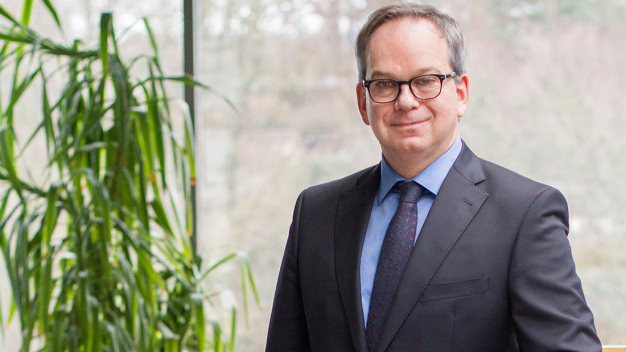
Professor Dr. Hans Schotten (Photo: DFKI)
To advance digitalization, the next generation of mobile communication standards, 6G, is indispensable. The Federal Ministry of Education and Research (BMBF) is funding a consortium with 17 partners ("Open6GHub") that is working on 6G standards and processes. Over the next four years, it will provide around 68 million euros. Approximately eleven million euros of this will go to the Technical University of Kaiserslautern (TUK) and the German Research Center for Artificial Intelligence (DFKI), where Professor Dr. Hans Schotten is coordinating the project. The focus includes data security, highly reliable data transmission, network availability, and novel computer networks.
With 6G technology, in the future, biosensors in personalized medicine, personal avatars for protection in road traffic, or as support in the workplace could be used. But 6G could also play a key role in achieving climate goals.
The "Open6GHub" – a consortium of 17 research institutions – will work to establish 6G as a key technology for a sustainable digitalization of society and the economy. "We focus our work on people and their sovereignty," explains the coordinator Professor Dr. Hans Schotten. "They will live in a highly connected world with autonomous devices and vehicles." In this context, particularly the protection of private data and complete system transparency play a significant role.
The consortium aims, among other things, to develop methods to ensure the resilience and reliability of 6G technology. To operate the technology resource-efficiently and energy-efficiently, as well as to increase economic viability, artificial intelligence techniques will be used to optimize 6G networks. Furthermore, the research teams will work on ensuring the availability of the technology everywhere and at all times, for example, with the help of satellites. Additionally, 6G will enable new, flexible computer networks that the project will address. The program also includes adapting the mobile communication architecture and developing new digital twins for industry, which can virtually mirror real work processes.
Professor Dr. Hans Schotten, who heads the Department of Radio Communication and Navigation at TUK and the Research Area of Intelligent Networks at DFKI, is coordinating the project at DFKI. From the side of TUK, Professor Dr. Marco Rahm (Department of Theoretical Electrical Engineering), Professor Dr. Norbert Wehn (Department of Microelectronic System Design), and Professor Dr. Stefan Götz (Department of Mechatronics and Electric Drive Systems) are also involved.
Professor Dr. Arnd Pötzsch-Heffter, President of TUK, is very pleased about the approval: "Congratulations to the colleagues from the Department of Electrical Engineering and Information Technology here at TUK and DFKI for this impressive project acquisition. The initiative, which will contribute to the sustainable digital transformation of society and industry, is a milestone in the excellent collaboration between TUK and the institutes at the site. I am also convinced that this approval signifies a major step forward for all communication technology and its applications and clearly demonstrates the role that Kaiserslautern plays in this field." Professor Dr. Werner Thiel, Vice President for Research and Technology at TUK, also welcomes the funding and emphasizes the importance of the project: "That we are now, after the ongoing 5G model region project and participation in the European 6G lighthouse project HEXA-X, also lead the development of the new 6G standard shows that Kaiserslautern is a leading location in the field of this key technology of digitalization."
In addition to DFKI and the working groups at TUK, 15 other universities and research institutions are involved in the project. The BMBF funds the work within the framework of the funding measure "6G Research Hubs; Platform for Future Communication Technologies and 6G," which is part of the BMBF 6G initiative within the implementation of the Federal Government's Future and Economic Stimulus Package. Besides the "Open6GHub" network, three other research hubs are also funded. More information is available at https://www.bmbf.de/de/karliczek-wir-wollen-bei-6g-an-der-spitze-sein-14820.html
At TUK, Professor Schotten already coordinates the project "5G Kaiserslautern – 5G for City, Country, and Work," funded by the Federal Ministry of Transport and Digital Infrastructure. The team around Schotten, together with its project partners from science and industry, researches 5G technology and its applications. The mobile communications expert is also involved in the European 6G project "HEXA-X," funded by the European Union. The goal is to look beyond 5G, lay the groundwork for 6G, and develop intelligent communication systems for a highly connected society after 2030.
Questions answered by:
Prof. Dr. Hans Schotten
Department of Radio Communication and Navigation / TUK
Tel.: 0631 205 3595
Email: schotten(at)eit.uni-kl.de
Technische Universität Kaiserslautern
67663 Kaiserslautern
Germany