


- Surface
- Translated with AI
Susanne Frank
Antimicrobial active coatings for contact and contamination surfaces in public areas
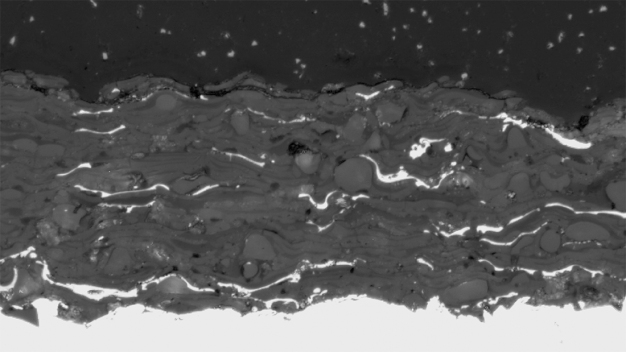
Cross-section of a cold plasma-sprayed Al₂O₃ coating (gray) with 5% Cu (white). Top: embedding resin, bottom: substrate. (INNOVENT e.V.)
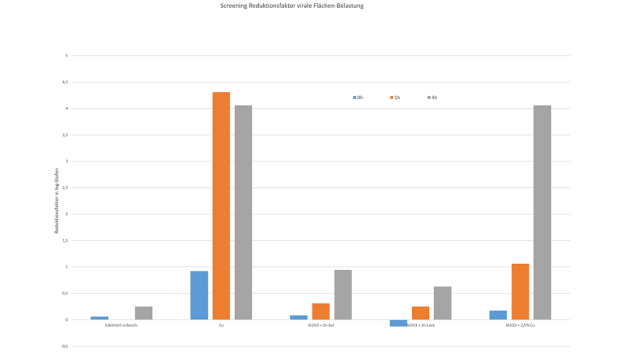
Influence of the composition of the coating on antiviral efficacy after 0h, 1h, and 4h. Since a pure Cu surface is highly reactive and oxidizes quickly, it is not suitable as a contact surface in public spaces. (INNOVENT e.V.)
Contaminated surfaces play a key role in the transmission and spread of microorganisms. Antimicrobial surfaces are therefore an important means of infection prevention. Especially through the COVID-19 pandemic, this topic has gained increased public awareness.
In the research project Safe TOUCH, funded by the IGF, it has been possible to develop a durable metallic/ceramic coating made of Al2O3 with permanently antimicrobial properties (through slight addition of Cu). The coating is a few micrometers thick and can be applied to all rough surfaces such as metals and heat-resistant plastics in various designs.
The new coatings are adherent and abrasion-resistant (comparable to hard anodizing!). The Cu particles improve the adhesion and abrasion properties of the Al2O3 coating.
Their antibacterial effect was successfully tested against E. coli (gram-negative) and S. aureus (gram-positive), as well as their antiviral effect using the example of the modified Vaccinia virus strain Ankara (MVA) and murine Norovirus (MNV). Tests were conducted according to ISO 22196 and ISO 21702, where the surfaces to be tested were brought into contact with a defined amount of bacteria or viruses. In tests designed for contact times of 24 hours, a very good effect was already observed after 60 minutes. The effect remains long-term stable even after tests for mechanical stress (washability) and chemical leaching of the surfaces (elution test).
This technology expands the range of available surface solutions in the fight against harmful viruses and bacteria. By applying permanently effective coatings, cleaning processes can be made more efficient and the use of chemical disinfectants reduced.
Cold plasma spraying – innovative technology for layer application
Plasma spraying is a special coating technology in which particles or wire material are melted in a plasma and deposited as a mechanically stable layer on the surface. A special form of this process is cold plasma spraying. Due to the lower plasma power and process temperature, thermally sensitive substrate materials such as plastics can also be coated depending on the process control.
The powders used generally have an average grain size of about 10 – 20 µm, making the deposition of coatings with a layer thickness between 20 and 100 µm economically feasible.
Project objectives
The coatings were developed in collaboration with the research association DECHEMA Society for Chemical Engineering and Biotechnology e.V. The goal was to develop a novel, long-lasting, antibacterial and antiviral active coating for everyday objects that are regularly touched by hands. This aims to reduce the risk of transmission of germs, bacteria, and viruses through contact/physical touch.
The preferred application areas include all areas of public life such as
– public buildings, event spaces, medical practices – handles and door levers, handrails, switches, terminals, furniture surfaces, ...
– transportation – handrails, buttons, seats, handles, ...
– retail facilities, restaurants – handles, tables and chairs, sanitary areas, ...
– companies / institutes / workplaces – workstations, keyboards, telephones, ...
Other potential areas of application for the coating include especially hygienic high-risk areas, including hard-to-reach and problematic places for cleaning routines.
Equipping wire meshes and filter ceramics with the coating minimizes biofilm formation, which leads to improved usability and longer lifespan.
INNOVENT e. V.
07745 Jena
Germany