

- Translated with AI
Also for smartphones: Kaiserslautern physicists develop an electronic iris diaphragm for mini cameras
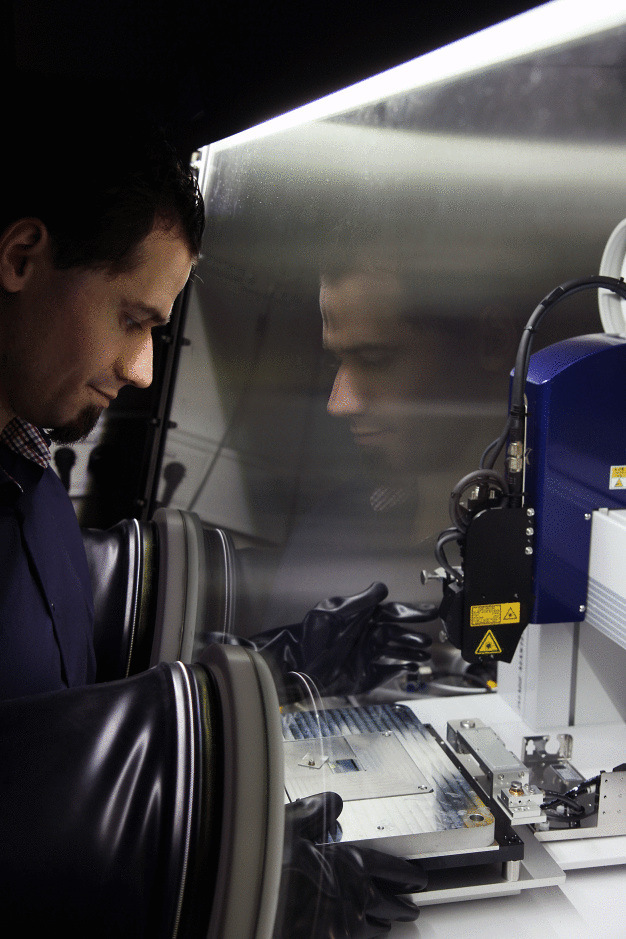
The physicists around Professor Oesterschulze assemble the micro-iris on a special workbench in a dust-free environment. In the picture, doctoral candidate Alexander Hein can be seen. (Photo: Thomas Koziel)
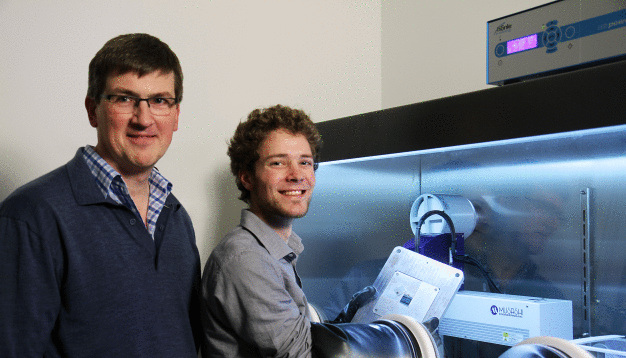
Professor Oesterschulze (left) and his doctoral student Alexander Hein. (Photo: Thomas Koziel)
Photographers use iris diaphragms to control the amount of incoming light and to set the depth of field. Due to their size and energy consumption, conventional diaphragms have limitations: they cannot be used in mini cameras like those in smartphones or tablets. The situation is different with micro-engineered diaphragms, which physicists at the Technical University of Kaiserslautern (TUK) and chemists at the University of Osnabrück are currently working on. They are developing an electrically controllable iris diaphragm suitable for mini cameras. The project is funded by the German Research Foundation.
When sunlight hits the eye, the pupil becomes smaller. The iris is responsible for this. It acts as a diaphragm and regulates how much light enters the eye. The same principle is used in the diaphragms of camera lenses. They control the amount of light passing through the lens. But they can also be used to control the depth of field of an image.
A conventional diaphragm consists of several movable blades that can pivot inward and outward. Together, they form an aperture whose size can be adjusted. "This mechanism requires a lot of space, which is why it is not used in smaller camera systems," says Professor Dr. Egbert Oesterschulze, who holds the Chair of Physics and Technology of Nanostructures at TUK.
The team led by Professor Oesterschulze is working on a technology that enables diaphragms to be used in micro-optical systems. "We use so-called electrochromic materials," says the physicist. "They change their optical absorption properties when an electric voltage is applied. This allows us to selectively darken individual ring-shaped areas, corresponding to the desired diaphragm stages of a conventional iris, and thus control the amount of light and the depth of field at the push of a button."
The method developed by the Kaiserslautern scientists works as follows: "The electrochromic molecules used are chemically bonded to the surface of a highly porous nanoparticle layer," explains the professor. When a voltage is applied to this conductive layer from outside, these molecules can absorb or let through the incoming light, depending on the voltage applied. "The thickness of this iris layer is about 50 micrometers, thinner than the diameter of a human hair. It requires very little space between two thin glass plates," says Oesterschulze. "This minimal space requirement, combined with low electrical energy consumption, makes it possible to use the electrochromic iris in micro-optical lenses." This would be interesting, for example, for smartphones but also for other micro-optical camera systems.
The work is funded by the German Research Foundation with a total of 430,000 euros. Among those involved is Professor Dr. Lorenz Walder from the Institute for Chemistry of New Materials at the University of Osnabrück.
Technische Universität Kaiserslautern
67663 Kaiserslautern
Germany