



- Building technology
- Translated with AI
Air sterilization is important – and not just in times of Corona
Air purified from viruses and pathogens is healthy air
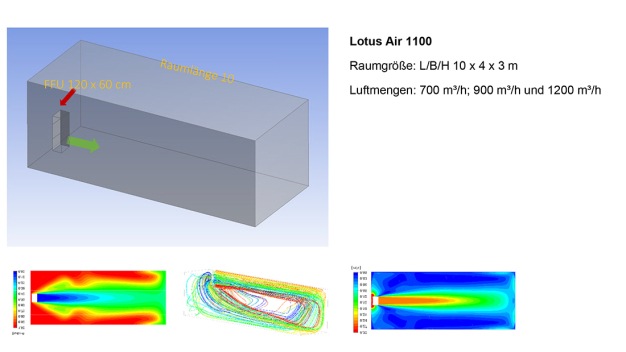
Simulation of airflow in the room and the filtering effect: Measurement results confirm a reduction of infectious aerosols in the room air, even with high occupancy and frequency, within a few minutes to over 95%.
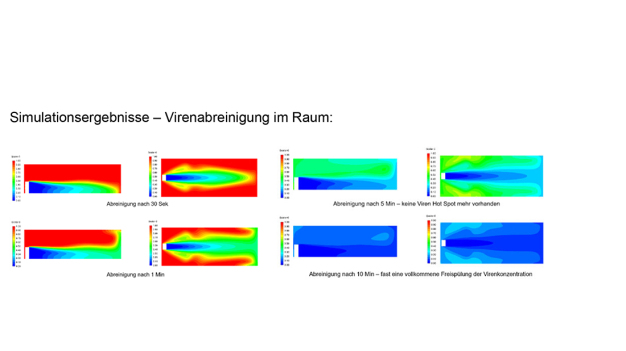
Simulation results – Virus removal in the room: The simulations show the effect of the fresh air ventilation in a room measuring 120 m³ (10 x 4 x 3 m), which was uniformly contaminated with germs. The free ventilation already demonstrates significant virus removal after just one minute of operation of the Lotus Air 2400. After 5 minutes, no more virus hotspots are present in the room, and after 10 minutes, the room is almost completely virus-free.
Aerosols and solid particles are responsible for many infections. As a mixture of solid and/or liquid suspended particles with very low weight, aerosols mainly float freely in the air indoors and can potentially contain viruses and pathogens.
Viruses, such as influenza or coronaviruses (size approximately 120 to 200 nm), are usually emitted as part of larger particles. The particles serving as carriers are known as droplets (diameter > 5 µm) or aerosols (diameter < 5 µm), depending on their size. Science agrees that airborne aerosols are the main cause of Covid-19 transmission.
The pathogens that spread through the air via droplet infection through open breathing, speaking, singing, and especially sneezing or coughing can often float in the air for hours and infect another person through inhalation. Of course, there is also a significant risk of contact transmission through the transfer of contaminated surfaces.
For this reason, cleanroom technology is concerned both with creating highly pure air and with sterilization and decontamination techniques. Expertise in handling dangerous germs is no longer only relevant for the particularly sensitive industries, but society as a whole needs effective solutions – and not only in times of Corona.
Know-how of cleanroom technology in use
In view of the global pandemic, a variety of different air purification devices are offered on the market. The available air filters and cleaning systems usually have a very limited effective range and efficiency in terms of removing pathogens from the room air due to their design and technology. Not every device or technology is truly designed for virus reduction. The performance often does not meet the necessary room-based removal or free airflow. This is exactly where cleanroom technology can make a valuable contribution.
Knowledge about air and filter technology
In traditional cleanroom technology, very large cleanrooms are built worldwide with so-called FFU (Filter Fan Units). Using cost-effective standardized FFU technology, depending on the FFU type, high air volumes are circulated in the room and filtered to be particle- and virus-free. This achieves a significantly improved dilution performance compared to window ventilation or standard ventilation systems. This technical method is well suited to ensure high infection protection in both public and private sectors.
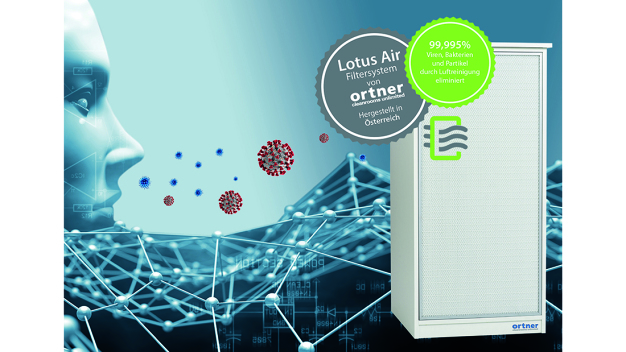
Specifically designed for individual needs, Ortner has launched a proven technology from the cleanroom industry that is affordable and easy to use. With the Lotus Air System, Ortner introduces a system long established and proven in the pharmaceutical, medical, electronics, and food industries, offering optimal protection against infections.
Hand in hand: performance and effectiveness
To create a germ-reduced environment, Ortner relies on methods of hard technology, the Coanda effect, and dilution principles in the Lotus Air System. The unique property of air, which always strives to cling to surfaces, is utilized to create a natural protective shell. The product or person to be protected is essentially placed in a clean air bubble, while the environment is continuously cleaned of pathogens and pollutants.
Using HEPA filter technology, the air is cleaned of all pollutants. Bacteria, viruses, allergens such as pollen, mold spores, aerosols, or solid particles that can also carry coronaviruses are demonstrably filtered out with an efficiency of over 99.995%. Discharged pathogens are rendered harmless over time through natural death or inactivation within the filter.
The effectiveness of air purification with Lotus Air has been tested and confirmed in collaboration with the research institute "Silicon Austria Labs" (SAL) and TU Graz through CFD simulations. The results speak for themselves: the simulation shows the effect of clean air flow in a room of 120 m³ (10 x 4 x 3 m), which was uniformly contaminated with germs. The free airflow already shows significant virus reduction after just one minute of operation of the Lotus Air 1100. After 5 minutes, no virus hotspots remain in the room, and after 10 minutes, the room is almost completely virus-free. Measurement results confirm a reduction of infectious aerosols in the room air, even under high occupancy and traffic, within a few minutes to over 95%.
The Lotus Air filter systems create a germ- and particle-free environment within a radius of up to 10 meters.
Safety in public life – From school classes to gastronomy and hotels to lounges
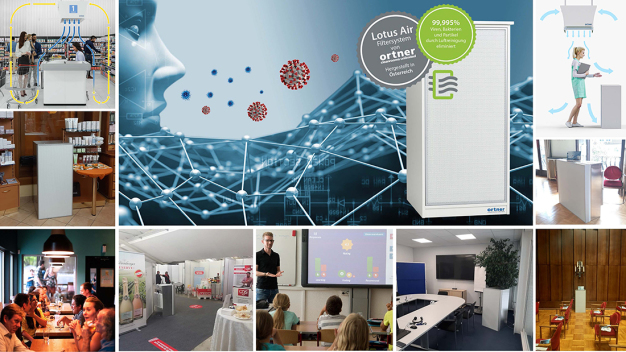
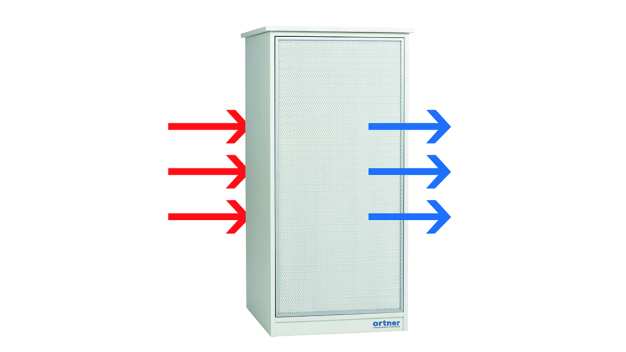
Adapted as an autonomous and mobile device, the Lotus Air System can be used in any enclosed space. The system creates a germ- and particle-free environment and is particularly versatile due to its no-draft air outlet and low noise level.
Especially suitable for critical zones such as checkout areas, reception desks, pharmacies, school classes, hotel lobbies, bars, lounges, or meeting rooms, as well as for various events like trade fairs and conferences. The new Lotus Air System not only improves indoor air quality but also effectively protects employees, customers, visitors, etc. Not only during the Covid-19 pandemic or flu seasons does this technology offer significant benefits. Germ-free filtered air also protects allergy sufferers and asthmatics from house dust and pollen.
Lotus Air – Function and design in harmony
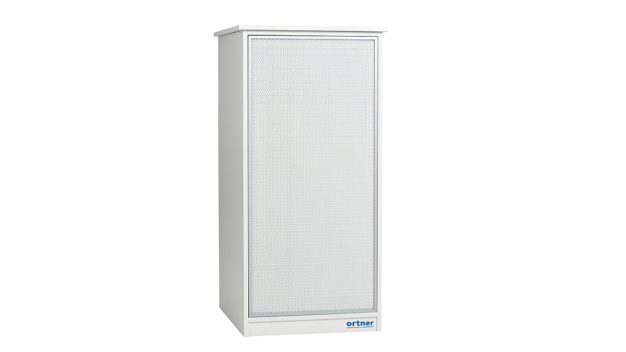
The Lotus Air System also meets aesthetic and timeless design standards. The technology is housed in an elegant casing made of high-quality chipboard materials and is available in white or wood design.
Due to the high air volume (approx. 1100 m³/h for the smaller, approx. 2300 m³/h for the larger model), Lotus Air systems guarantee significant room air circulation with a very low noise level of about 35 dBA (measured at 5 meters distance).
The HEPA filters used have a very long lifespan: 5 years or longer with proper pre-filter maintenance. The maintenance effort is minimal (pre-filter replacement can be performed by the user 1-2 times a year).
The system is delivered as a plug-and-play unit (connected to a standard 220V socket) and, depending on the fan speed setting, consumes between 100 and 250 watts per hour.

Ortner Reinraumtechnik GmbH
Uferweg 7
9500 Villach
Austria
Phone: +43 4242 3116600
Fax: +43 4242 3116604
email: reinraum@ortner-group.at
Internet: http://www.ortner-group.at



