


- Pressure
- Translated with AI
Air change rate and differential pressure: Key parameters in cleanrooms
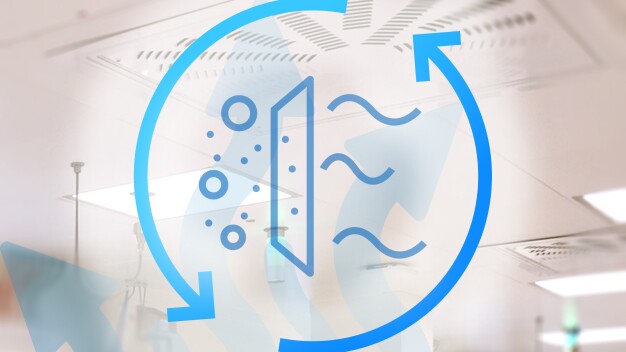
A properly functioning cleanroom largely depends on the interplay of physical parameters. Especially air change rate and differential pressure influence the purity and safety of the environment – and should therefore not be considered in isolation during planning and operation, but understood holistically.
Cleanrooms are highly controlled environments where particles, microorganisms, and other contaminants are minimized. For a cleanroom to fulfill its function – whether in pharmaceutical manufacturing, laboratories, or clinical areas – various physical parameters must be precisely regulated. Two of these key parameters are the air change rate and the differential pressure. Both are closely interconnected and crucial for maintaining the cleanliness and functionality of a cleanroom system.
What is the air change rate?
The air change rate (ACH – Air Changes per Hour) describes how many times the volume of air in a room is completely replaced with filtered air within one hour. It is a measure of airflow and directly influences the particle concentration in the room. The higher the air change rate, the faster contaminants introduced are removed.
Typical values:
– Cleanroom class ISO 8: approx. 10–20 air changes per hour
– Cleanroom class ISO 7: approx. 30–60 air changes per hour
– Cleanroom class ISO 5: over 100 air changes per hour (e.g., in laminar flow workstations)
What is the differential pressure?
The differential pressure is the pressure difference between two adjacent zones in the cleanroom. It ensures that air always flows from the "cleaner" zone to the "less clean" zone, preventing the spread of contamination. In a typical cleanroom cascade, staged pressure zones are therefore established.
Example of pressure staging:
– Black area (e.g., corridor or ante-room): 0 Pa (ambient pressure)
– Airlock (gray area): 15 Pascals
– Clean area (e.g., production room): 30 Pascals
– Ultra-clean area (e.g., aseptic room): 45 Pascals
These pressure differences may seem small at first glance – one Pascal is roughly equivalent to the pressure exerted by a 0.1 mm high water column – but they are highly effective in controlling airflow.
Correspondingly, the requirements for the differential pressure measurement devices are high: they must be extremely sensitive, stable, and capable of long-term precise measurements to reliably detect even the smallest deviations and thus ensure the continuous function of the cleanroom.
How are air change rate and differential pressure related?
Both parameters work together to achieve the desired cleanroom classification:
– A high air change rate ensures rapid dilution and removal of particles and microorganisms.
– The differential pressure ensures that air flows controlled through the room zones – always from cleaner to less clean.
An exception is in the production of hazardous substances such as cytostatics: here, the manufacturing room is deliberately operated at a lower pressure to prevent contaminated air from escaping into adjacent areas – personal safety takes precedence over product protection.
– To maintain a stable differential pressure, the amount of supplied air must always be slightly greater than the exhausted air – this requires precise coordination of air volumes (supply air vs. exhaust air).
– Conversely, an unstable differential pressure negatively affects the airflow direction, which can lead to contamination risks despite a high air change rate.
Conclusion
A functioning cleanroom relies on the interplay of multiple parameters. Air change rate and differential pressure are central control variables that must not be considered in isolation. The physically small pressure differences of 15–45 Pascals act as invisible barriers within the overall system and are crucial for controlled and safe production. Those involved in planning or operating cleanrooms should develop a fundamental understanding of these parameters – because only with a stable environment can cleanliness requirements be reliably met.

BRIEM Steuerungstechnik GmbH
Lauterstraße 23
72622 Nürtingen
Germany
Phone: +49 7022 60920
Fax: +49 7022 609260
email: info@briem.de
Internet: http://www.briem.de