


- 3D printing
- Translated with AI
Additive manufacturing sheds light on the dark.
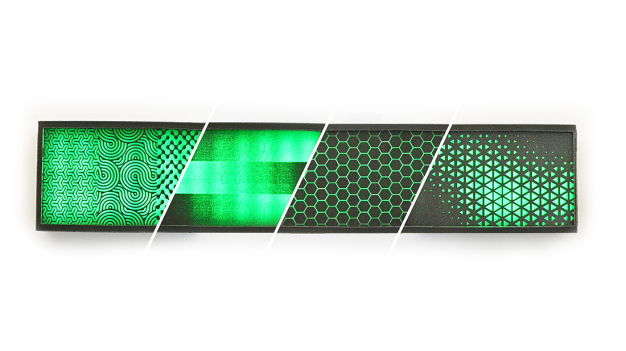
Backlit patterns – creativity knows no bounds. © Fraunhofer IPA / Photo: Christian Bay
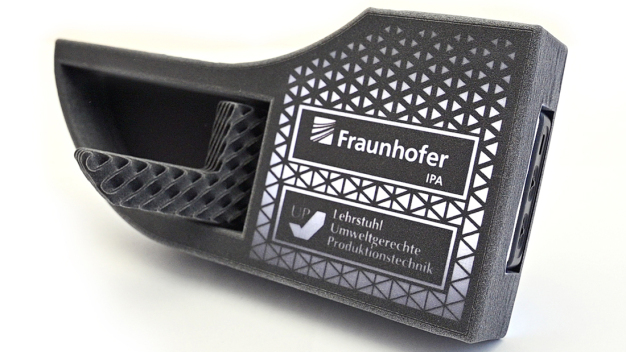
Backlit door paneling from the 3D printer. © Fraunhofer IPA / Photo: Christian Bay
The production is elaborate, and recycling is difficult: Complex plastic components that need to be translucent at certain points demand quite a lot from manufacturers and disposal companies. Using an ingenious 3D printing process, experts from Fraunhofer IPA and the University of Bayreuth have now succeeded in producing these components in just a single manufacturing step and entirely from the same material.
Whether dashboard, trim strips, or backlit buttons and switches for air conditioning and radio – many automotive components and electrical devices feature lighting elements or selectively illuminated symbols. The contrast between dark background and bright symbol helps drivers quickly recognize the desired button at night and stay focused on the road.
Even for small parts like buttons and switches, manufacturing illuminated symbols requires multiple materials with different light transmittances, various process steps, or changing component thicknesses. These materials are usually inseparably bonded, which significantly reduces recyclability. The process innovation project group at the Fraunhofer Institute for Production Technology and Automation IPA and the Impact Hub of the Chair of Environmentally Friendly Production Technology at the University of Bayreuth are utilizing additive manufacturing to make the production of these functionalized plastic parts more ecological and economical.
»Recyclability and short process times are becoming increasingly important in the production of technical components, especially in additive manufacturing«, says Marco Wimmer from Fraunhofer IPA. »By harnessing the potentials of additive manufacturing along with innovative materials and machine technologies, new manufacturing possibilities for functionalized components are emerging.«
From powder to selectively translucent components
The research team around Wimmer uses finely ground thermoplastic plastic powders as the starting material for the additive manufacturing of selectively translucent components. Suitable materials include soft thermoplastic elastomers, rigid plastics like Polybutylene Terephthalate (PBT), or transparent and translucent copolymers. These and other commercially available or still in development plastic powders are parameterized by the Bayreuth scientists for High Speed Sintering (HSS) and tested in processing. The team presents its results in the »HSS Material Network«, a network aimed at increasing the availability of plastic powders for service providers and users.
HSS belongs to the powder bed fusion methods of »Powder Bed Fusion of Polymers with Infrared Radiation« (PBF-IR/P), a group of additive manufacturing processes where a thin layer of plastic powder is applied to a heated build platform and then coated with a viscous ink via inkjet nozzles. An infrared radiation source then scans the powder bed. The ink's dye absorbs the radiation, heats up, and selectively melts the plastic powder. By varying the amount of ink applied, the team can locally influence the properties of the components.
Light and shadow are closely intertwined
Whether an area is translucent depends on the amount of dye applied locally to the plastic powder via the ink. Only a small amount of dye is needed to melt the plastic powder, which slightly lightens the component to a light gray, but the translucent properties of the plastic powder predominate. If more than the minimal amount needed to melt the plastic powder is applied, the light transmittance decreases accordingly in that area.
The scientists in Bayreuth deliberately exploit this interaction to produce additively manufactured parts with highly detailed patterns, inscriptions, and symbols, which can be illuminated with a light source. Thanks to the high resolution of the inkjet nozzles, smooth transitions and contrasts between light and dark can be realized.
Ecological and economical on the fast lane
Customized patterns, inscriptions, and symbols, complex three-dimensional structures with light elements, or translucent components for combinations of sensing and lighting – all of this can be produced in a single manufacturing step and without structural modifications to the components thanks to this sophisticated 3D printing process. And because the plastic parts are made entirely from the same material, they can be easily recycled.
»Additive manufacturing relieves nature and the economy: Through sustainable production and short process chains, components can be functionalized with selectively translucent structures without structural restrictions«, summarizes Wimmer.

Fraunhofer-Institut für Produktionstechnik und Automatisierung IPA
Nobelstraße 12
70569 Stuttgart
Germany
Phone: +49 711 970 1667
email: joerg-dieter.walz@ipa.fraunhofer.de
Internet: http://www.ipa.fraunhofer.de