



- R+D & Community of Interest
- Translated with AI
A lot of optimization potential in the digitization of laboratories
© Fraunhofer IPA
Desire and Reality: A current study by Fraunhofer IPA and Parametric Technology GmbH (PTC) shows that digitalization in life science laboratories still offers much potential for further optimization. However, the vast majority of respondents would like to better exploit this potential in the future. They see particularly great potential in applications of augmented reality.
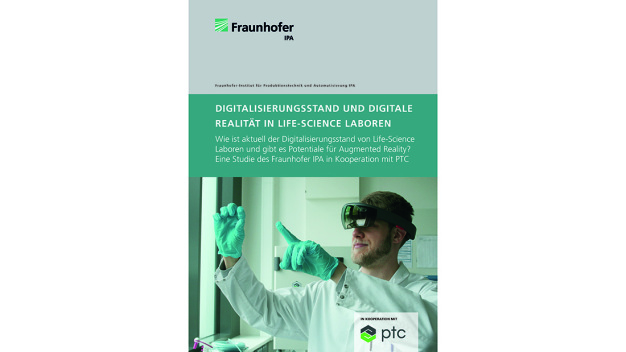
The level of digitalization, automation, and networking still offers much room for improvement in laboratories. Employees and managers lose valuable time every day on non-value-adding activities and are confronted with many challenges that digital tools could support. This is one of the findings of the study "Level of Digitalization and Digital Reality in Life-Science Laboratories," conducted by researchers from the Fraunhofer Institute for Production Technology and Automation IPA together with staff from the global technology company PTC.
So far, daily work in laboratories is dominated by analog activities and partly digital isolated solutions. Both employees and managers express a desire to further advance digitalization in their laboratories. "However, this wish is often hindered by reality," says study author Milena Frahm from the Department of Laboratory Automation and Bioproduction Technology at Fraunhofer IPA. "In many laboratories, digitalization progresses slowly mainly because of a lack of time, money, and interfaces." Another major obstacle identified by respondents was gaining acceptance for digital solutions among all staff members. Furthermore, many laboratory employees and managers reported that they lack sufficient knowledge about the technical possibilities of new technologies to identify meaningful areas of application.
More time for value-adding activities thanks to AR
Augmented reality applications (AR applications) offer profitable areas of use in life science laboratories. However, the study participants were unable to quickly name specific applications because their technological understanding in this regard is still insufficient. Nonetheless, there is generally a strong interest in this technology and a willingness to use it.
The number of non-value-adding activities in laboratories is high. On average, employees spend 25 percent of their daily working time on such tasks. For managers, it is even 33 percent. These include, for example, parts of documentation, which account for an average of 26 percent of daily working time in the laboratory. "Potential AR solutions can improve the quality of documentation, make work easier, and possibly even accelerate it," says study author René Zölfl, Business Development Director at PTC. This would leave more time for experiments and thus for value-adding activities.
But digitalization could also provide significant added value in areas such as device operation and maintenance, inventory management, safety, training and onboarding in new fields, as well as internal and external communication. AR could serve as a possible approach for this.
Study results are available free of charge
For the conducted study, Frahm, Zölfl, and their colleagues conducted detailed interviews over a period of three months with 26 employees and managers from twelve companies. The results of their study should be seen as a snapshot of the current mood. In a webinar on March 2, 2021, Frahm and Zölfl will briefly and concisely report on the study's findings and show what potentials can be derived (see info box).
The study "Level of Digitalization and Digital Reality in Life-Science Laboratories. What is the current state of digitalization in life science laboratories, and are there potentials for augmented reality?" is available for free download:
https://www.ipa.fraunhofer.de/de/Publikationen/studien/digitalisierungsstand-von-life-science-laboren.html

Fraunhofer-Institut für Produktionstechnik und Automatisierung IPA
Nobelstraße 12
70569 Stuttgart
Germany
Phone: +49 711 970 1667
email: joerg-dieter.walz@ipa.fraunhofer.de
Internet: http://www.ipa.fraunhofer.de