




- Cleanroom
- Translated with AI
A cape for all cases
It is often seen among cyclists and hikers, but Ötzi, the glacier mummy, also wore it, as well as the bog body from Kayhausen — a cape: a sleeveless, lightweight cloak designed to protect against wind and weather. 5,000 years ago, it was made of grass; in 364/350 BC, from fur; today, from textile and synthetic materials: compact to pack, easy to unfold when needed, and quick to put on.
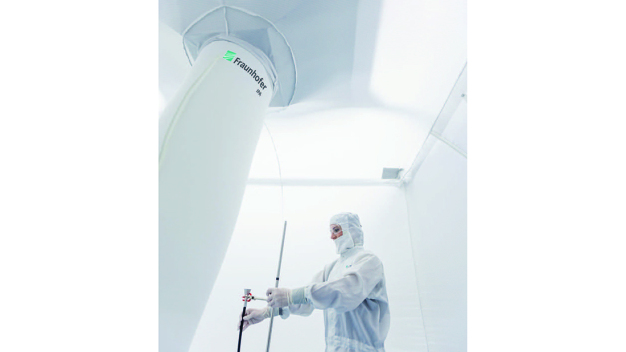
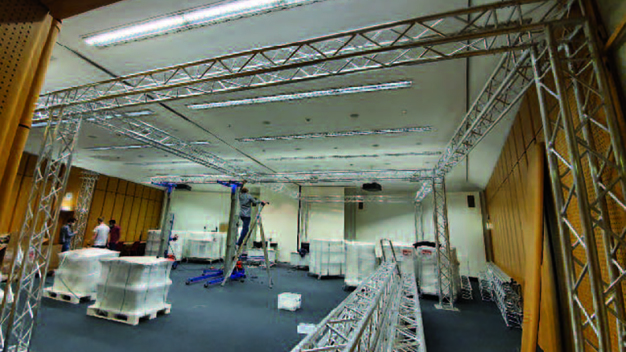
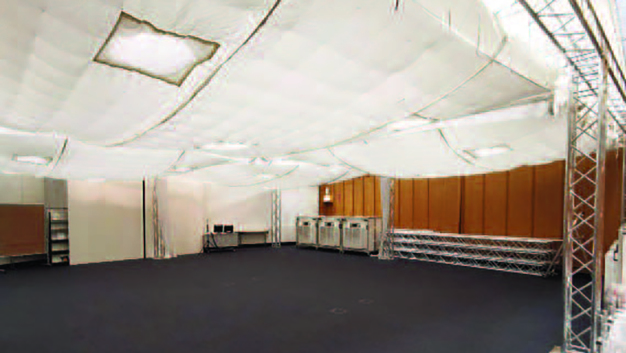
Scientists at the Fraunhofer IPA also thought of a cape when they designed a mobile cleanroom in 2015 together with an aerospace company. This was intended to additionally protect highly sensitive hardware within a high-grade cleanroom. "The idea was to create a cleanroom environment through a mobile and quickly installable, autonomous system," says Udo Gommel, head of the Intelligent Automation and Cleanliness Technology division. The cooperation partners jointly developed a mobile cleanroom that allows users to house hardware on an area of about four by four meters in approximately one hour. The "Clean And Protective Environment" was born, called "CAPE®" for short. It offers temporary protection against particulate and molecular contamination during product inspections or cleaning processes, during new installations in the cleanroom, or during routine maintenance and repairs. But other applications are also conceivable: as a mobile operating room, as a quarantine room during pandemics to protect people and the environment from contamination, as maintenance CAPE® in the semiconductor industry, or as a testing and consulting center for healthy indoor air during the COVID-19 pandemic.
Healthy Air
Can ventilation and air purification systems protect against Covid-19? How must they be designed for this purpose? And how should hygiene and ventilation concepts be structured to reduce virus transmission via aerosols? Answers to these questions are provided by a research team from the Fraunhofer Institutes IBP, IGB, and IPA in a testing and consulting center for healthy indoor air. As part of the Healthy-Air initiative of the state of Baden-Württemberg, they aim to assist small and medium-sized enterprises in implementing ventilation concepts to prevent the spread of the coronavirus in workplaces. But first, it was about finding suitable premises.
Searching for a testing environment
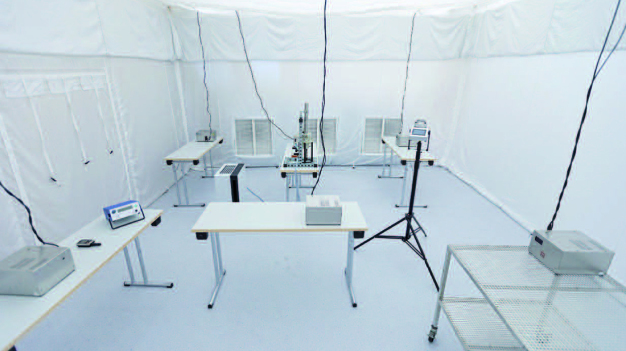
To test and compare air cleaning technologies, the scientists designed two representative test environments: a facility the size of a factory hall and a small office as a workplace. One challenge was to replicate the sheer size of such a facility in a scenario. Another was that the space had to be equipped with appropriate ventilation, climate, and cleaning technology. Additionally, it needed to be decontaminated biologically-virologically and also regarding its particle concentration. And ultimately, such a clean testing environment should be operational in the shortest possible time.
Such a (clean) room was not available to the three institutes. However, what the cleanroom experts had on hand was a CAPE®, the system originally developed for aerospace. Additionally, a pandemic-related closed lecture hall was unused.
The cleanest lecture hall in the world
The hall named after Fraunhofer President and IPA Director Hans-Jürgen Warnecke is located at the Fraunhofer-Gesellschaft Institute Center in Stuttgart. It can be divided into two areas of approximately 95 m² and 92 m² with sliding panels, and depending on the seating arrangement, accommodates 78 to 160 visitors. Along a nearly 14-meter side, the hall tapers trapezoidally towards the stage, with a width of 17 m narrowing to 10 m. Its height is about 7 meters.
The existing CAPE® has an area of 100 m² and a height of 7 m. It perfectly matched the scenario of a factory hall workplace and, with a few additional modifications, fit exactly into the available lecture hall. The height of the CAPE® system was slightly adjusted, and wall panels of the lecture hall were removed. This optimized the space utilization. Then, the experts installed a removable partition wall. The floor was covered with cleanroom floor panels. After two days of setup, the test environment was ready, a system that can normally be operational within a few hours and dismantled quickly afterward.
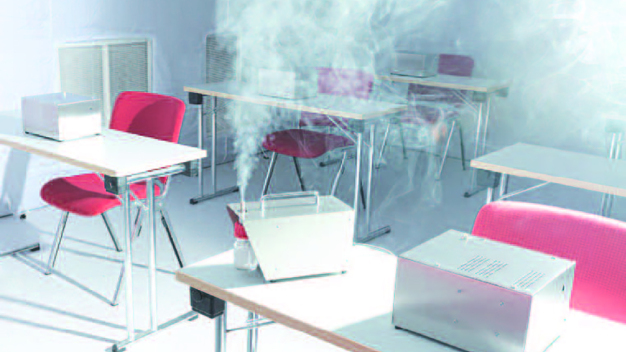
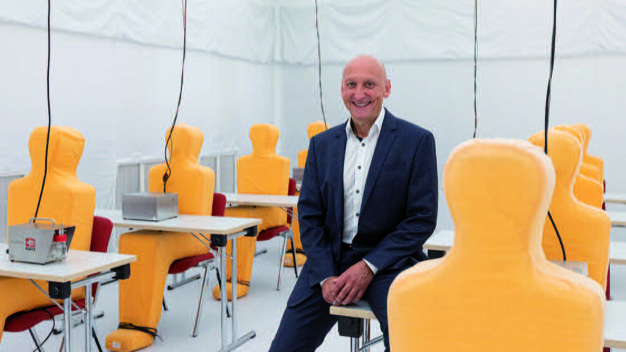
Three-quarters of the space is occupied by a kind of meeting room with tables and chairs. In the separated quarter of the test environment, the Fraunhofer scientists set up a second configuration simulating an office of 25–30 m². In the cleanest lecture hall in the world, the scientists will initially conduct efficacy tests of air purification technologies until December 31, 2021. They will also review in an expert paper how mobile and fixed ventilation systems influence the spread of infectious SARS-CoV-2 aerosols.
Measuring with artificial aerosols
In the large test environment of the meeting room, aerosols are evaluated. Aerosols are initially just particles, airborne particles that form a cloud. To measure particle concentration, the scientists use artificial aerosols. They produce these by vaporizing diethylhexyl sebacate, or DEHS, a evaporating, oily liquid. This creates droplet aerosols that are very similar to those contaminated with coronaviruses but harmless to humans and the environment. Most of their particles are between 0.2 and 0.3 μm in size. They also float similarly to viruses. 0.3-μm DEHS particles evaporate completely after about 4 hours, remaining in the room as long as coronaviruses can float and be inhaled.
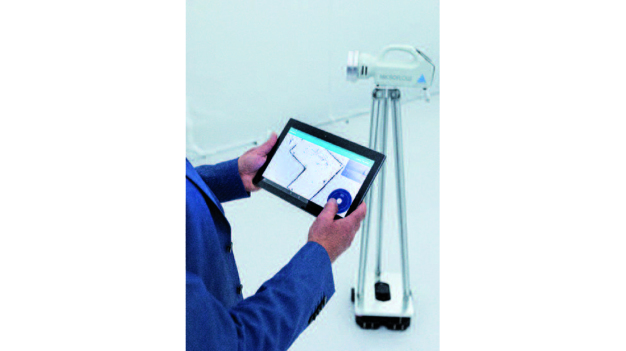
12 particle counters measure particle concentration at different locations and heights. "We can clearly see where areas contaminated with particles are, or where airflow supplies better and can thus carry away potential viruses," explains Gommel. "I can precisely identify where particle contamination reaches the workplace."
In the second test environment, the office, the experts evaluate virus removal. The viruses are analyzed before and after measures to improve air quality regarding their activity and quantity. "After the tests, we can draw conclusions about necessary adjustments to ventilation systems or inactivation steps," says Gommel. There is also the possibility of decontaminating the room with UVC radiation, which is done to restore the room to its defined original state after each test.
The scientists also measure chemical byproducts, temperature, and humidity in the test environment. Especially humidity plays a crucial role in the size of particle fractions and thus in infection dynamics. The drier the air, the smaller the particle fractions, and the longer particles stay airborne and can be inhaled. When the air is more humid, particles agglomerate, their fractions become larger, and they fall to the ground under gravity. Additionally, dry air makes mucous membranes more susceptible to viral attachment, increasing infection risk. Acoustic values also play a role in the tests: if a device's noise level is too high, users tend to switch off the air purifier.
Blown away
The main method to control airborne contamination is airflow technology. It originally developed about 60 to 70 years ago in cleanrooms. Initially, horizontal airflow was established, blowing contamination away from the source.
"We follow a similar approach with air purification concepts. We identify where the virus-laden aerosols are least critical for humans and direct the airflow accordingly to blow contamination away," explains the cleanroom expert. The air is passed through filter media and cleaned.
Air purifiers operate with different systems. Some draw air in from the back and blow it out at the front. The disadvantage of this approach is the so-called chill factor: individuals feel drafts, which cool them and cause discomfort.
Another concept involves purifiers that release air through a diffuser and direct it upward. This approach aims for even reduction through room turbulence, decreasing the concentration of airborne particles. Since heated air rises when speaking, and more virus-laden aerosols are expected there, some manufacturers install units on the ceiling to suck air from above, not from the workstation height. Moisture in speech results in emitted droplets on visors and protective glass. It shows that aerosols do not immediately diffuse upward; they don't just vanish. The key question remains: what can reach and influence the employees? Since they sit at their desks, the workspace should also be evaluated. In any case, the placement of the air purifier must be carefully considered.
The tests begin
After developing and validating the methods and setting up the test environment, the tests commence. Initial orders have been received. The test results are compared, and a cross-analysis is provided to the manufacturers. They see where their device ranks compared to the average result. The device's manufacturer and model name are grayed out; only the manufacturer can see how their device performs in the ranking compared to others.
Maintenance CAPE® in the semiconductor industry
The semiconductor industry has the highest requirements regarding contamination control. Its cleanrooms must also be free of chemical components that could disrupt processes like coating. Maintenance or assembly work presents similar challenges as in aerospace. It was only a matter of time before IPA experts presented the concept to semiconductor producers. "The difficult task was to configure the system so that it remains installed within manufacturing areas and equipment during maintenance intervals of 1 to 3 days and can be dismantled quickly afterward. One challenge is the very tight space constraints. Every centimeter is used for machines. A CAPE® system designed for aerospace already requires too much space," Gommel explains.
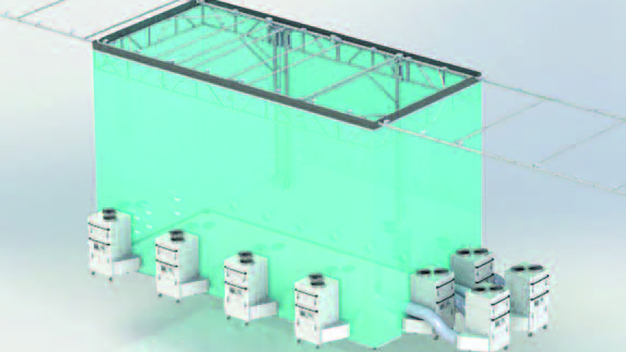
A new strategy was needed. A deployable, flexible CAPE® system was developed. It is mounted once in the ceiling area, has a stiffening frame, and is then lowered from the ceiling over the equipment to be maintained. Inside, the air is extracted so that no contamination escapes during maintenance.
The key was the airflow technology. Usually, air is blown in from above and removed via a perforated double floor. The ceiling systems installed in such setups cover 100% of the ceiling with filters for continuous operation. In CAPE®, however, more air must be extracted than is supplied from the ceiling to generate a negative pressure, preventing contamination from escaping. The crucial element is the CAPE® wall. It must allow air to flow in. This requirement is met by a textile with a precisely defined airflow opening area.
From this maintenance CAPE®, the engineers developed a special application that can be placed over equipment. "2ndSCIN" is the custom-made suit for machines. It provides protection against emitting contamination and extends maintenance cycles.
Besides aerospace and semiconductor industries, other sectors such as optics, food, pharmaceuticals, and medical technology also have a demand for mobile and autonomous cleanrooms.
Interest from other industries is also shown, as evidenced by an order for a 150 m² CAPE® system from a Bavarian automotive supplier.
A CAPE® can be purchased as a standard product or as a customized model. When designing and manufacturing custom models, the intended use, desired size, and required air cleanliness class are taken into account.

Fraunhofer-Institut für Produktionstechnik und Automatisierung IPA
Nobelstraße 12
70569 Stuttgart
Germany
Phone: +49 711 970 1667
email: joerg-dieter.walz@ipa.fraunhofer.de
Internet: http://www.ipa.fraunhofer.de



