



- Universities
- Translated with AI
Anne Eichhorn
€68 million for new cleanroom at the Center for Micro- and Nanotechnologies at TU Chemnitz
Free State of Saxony creates the foundation for a new cleanroom at the Center for Micro- and Nanotechnologies at TU Chemnitz with a multi-million euro investment, thereby strengthening research infrastructure and technology transfer in Southwest Saxony.
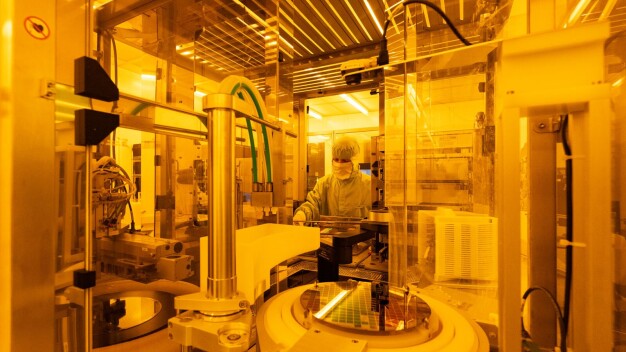
The planned new construction of a cleanroom for research and technology development in the field of sustainable microelectronics and sensor technology at the Center for Micro- and Nanotechnologies (ZfM) at TU Chemnitz strengthens the research infrastructure at Chemnitz University and the Southwest Saxony region. (Photo: Jacob Müller)
The Free State of Saxony supports the structural transformation in South-West Saxony with additional million-euro investments in science and research. One of the largest planned investments is the construction of a new cleanroom for research and technology development in the field of sustainable microelectronics and sensor technology at the Center for Micro- and Nanotechnologies (ZfM) of the Technical University of Chemnitz. The approximately 68 million euro building will be financed using unspent EU funding. Subject to approval by the European Commission, this will enable the implementation of a project that strengthens TU Chemnitz's research infrastructure and creates new opportunities for collaboration with research institutions and companies. This was announced by the Saxon State Ministry for Science, Culture and Tourism in a press release published on August 25, 2026.
"We are absolutely delighted that, even in these fiscally challenging and tense times, the construction of the new cleanroom for research and technology development in the field of sustainable microelectronics and sensor technology can be realized. This is an extremely significant investment in TU Chemnitz, especially its core competence in materials and intelligent systems, as well as the entire South-West Saxony region. We sincerely thank the Saxon state government, particularly Prime Minister Michael Kretschmer and Minister of Science Sebastian Gemkow, as well as all other stakeholders for their tremendous support!"
Prof. Dr. Gerd Strohmeier, Rector of TU Chemnitz, states: "With the planned cleanroom, the ZfM will further expand its expertise in micro- and nanotechnologies. The focus will be on technologies for sustainable microelectronics and sensor technology. The new infrastructure will provide the foundation for cutting-edge research and technology development and aims to intensify collaboration with non-university research institutions and companies."
"The planned new cleanroom is a milestone-like impulse for the Center for Micro- and Nanotechnologies at TU Chemnitz. Through these forward-looking investments, our research can be further expanded and strengthened at the highest level. The state-of-the-art infrastructure is an immense motivation for our staff and also acts as a magnet for international top scientists. We are thus creating the best conditions for researching sustainable microelectronics, the latest technologies in quantum, neuromorphic, photonics, and intelligent sensorics, while also forging an even stronger link between excellent research and industrial application. As an important regional player, we are making a significant contribution to value creation—benefiting regional partners sustainably,"
says Prof. Dr. Harald Kuhn, holder of the Chair for Smart Systems Integration at the Faculty of Electrical Engineering and Information Technology at TU Chemnitz, head of the Fraunhofer Institute for Electronic Nanosystems ENAS, and director of the ZfM at TU Chemnitz.
The planned investment is part of a comprehensive package of measures by the Free State of Saxony to strengthen the science and research location in South-West Saxony. This includes 79 European research funding projects (EFRE/JTF) in the machinery and plant engineering sector with a volume of more than 80 million euros, as well as projects totaling over 200 million euros in the medium-term financial planning until 2031.
Background: The Center for Micro- and Nanotechnologies (ZfM)
With the ZfM, TU Chemnitz has one of the world's leading research centers for microsystem technology and nanotechnologies. It is one of the technological cornerstones of the South-West Saxony industrial region and an indispensable pillar of Silicon Saxony. Research focuses include miniaturization of systems, energy efficiency, performance enhancement with reduced resource use, and the integration of micro- and nanoscale components into complex systems.
Microelectronics is the foundational technology for AI, medical technology, autonomous systems, energy and mobility solutions—and thus the backbone of industrial transformation. With over 120 German and 49 European partners, the ZfM acts as a global development partner for industry. The planned new building is therefore more than just a construction project; it is also of strategic importance. It will secure and expand over 300 highly qualified jobs in Saxony.
(Source: among others, press release from the SMWK dated August 25, 2026)
TU Chemnitz
09111 Chemnitz
Germany